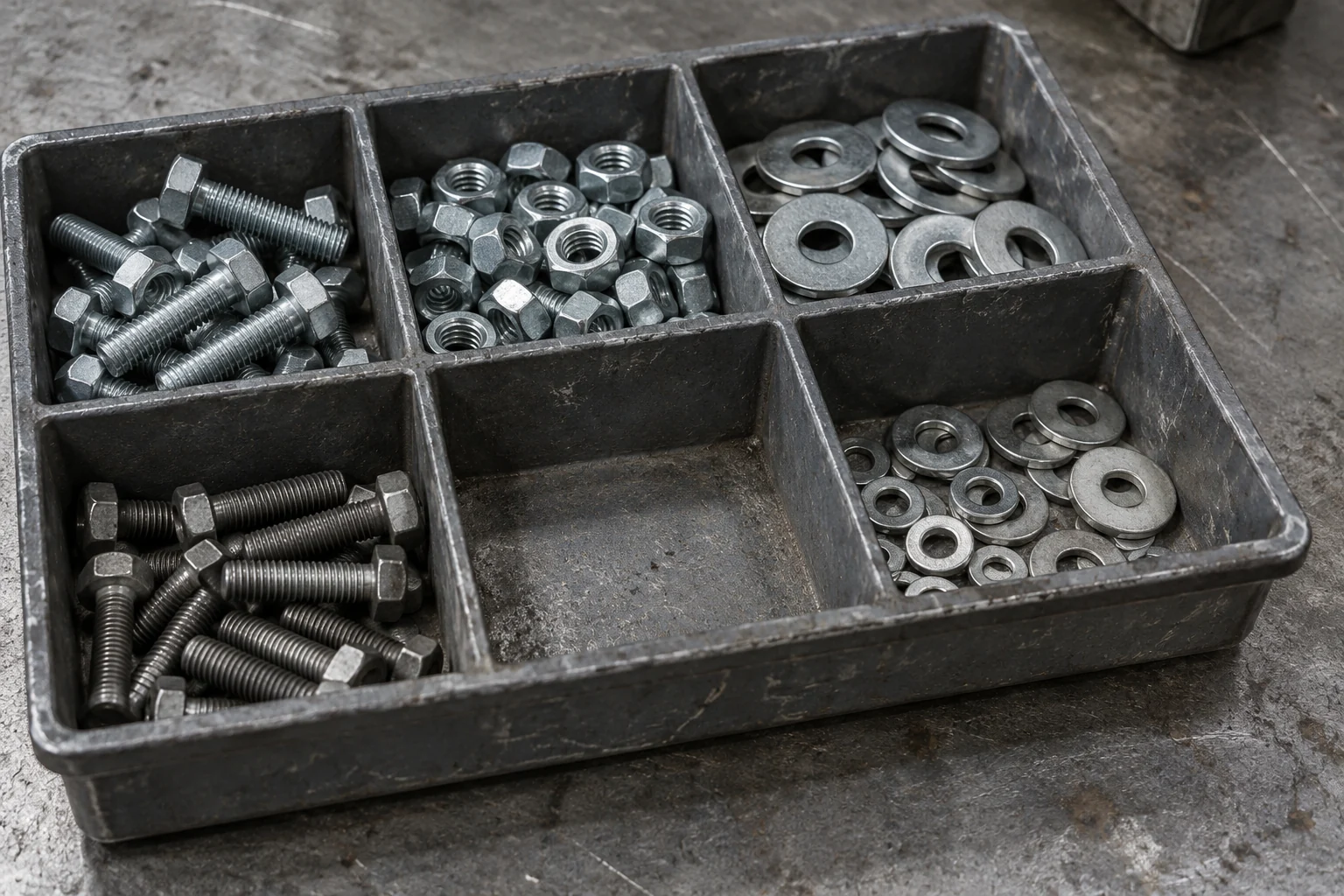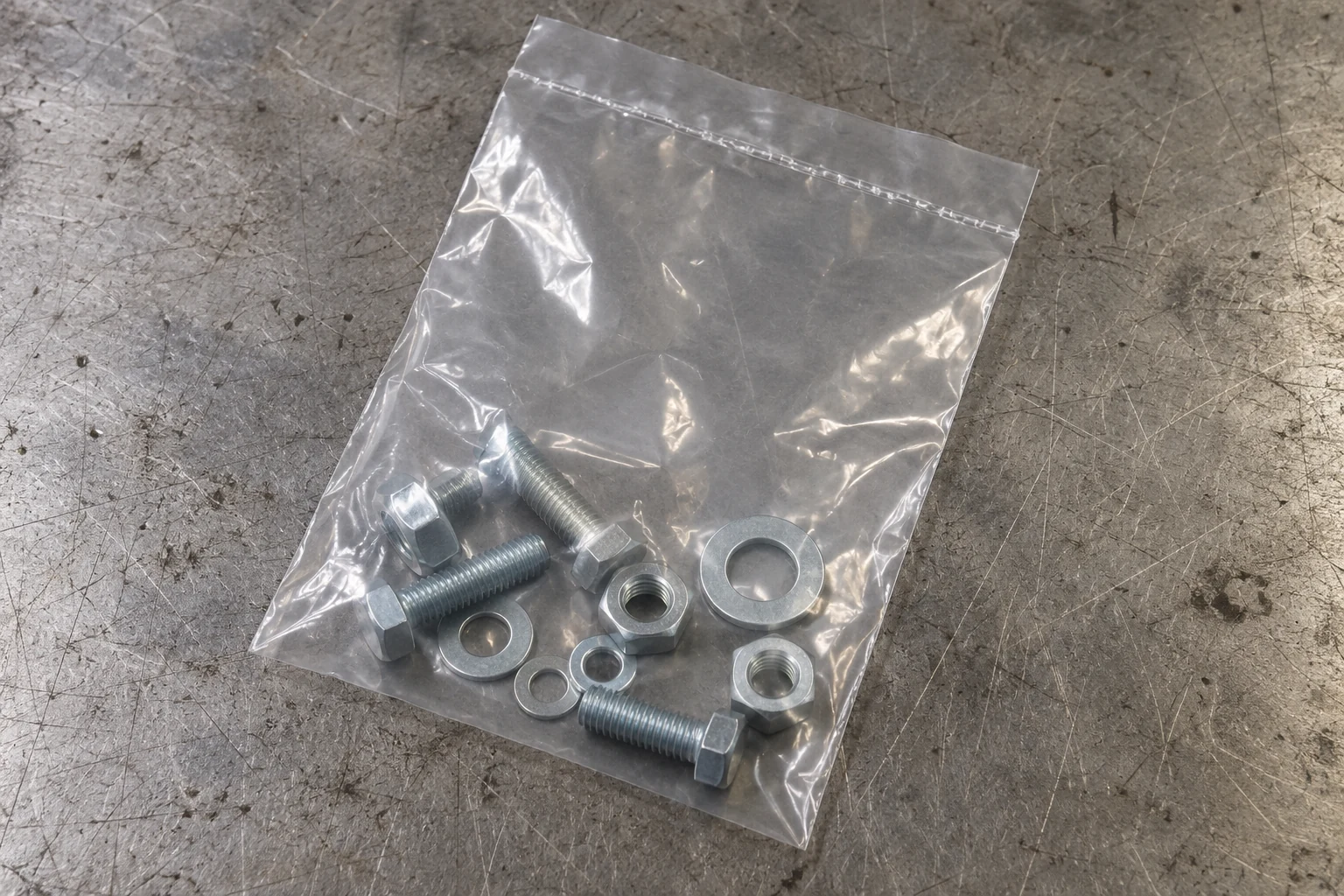
Packing small hardware kits, fastener assortments, or spare-parts orders into loose flat polybags without automated bag presentation causes slow 12.5 s manual cycles, premature perforation tear-offs, barcode queue scrap, and unscheduled workstation rework. Configuring a tabletop bagging machine—specifically a pre opened roll bagger or tabletop autobag style bagger—requires matching all-electric versus 80 PSI pneumatic actuation to bench utilities, tuning 100 to 250 ms DC blower inflation at the offset slit front lip, and integrating Next-Bag-Out thermal transfer overprinting inside a 75 to 110 lb (34 to 50 kg) footprint.
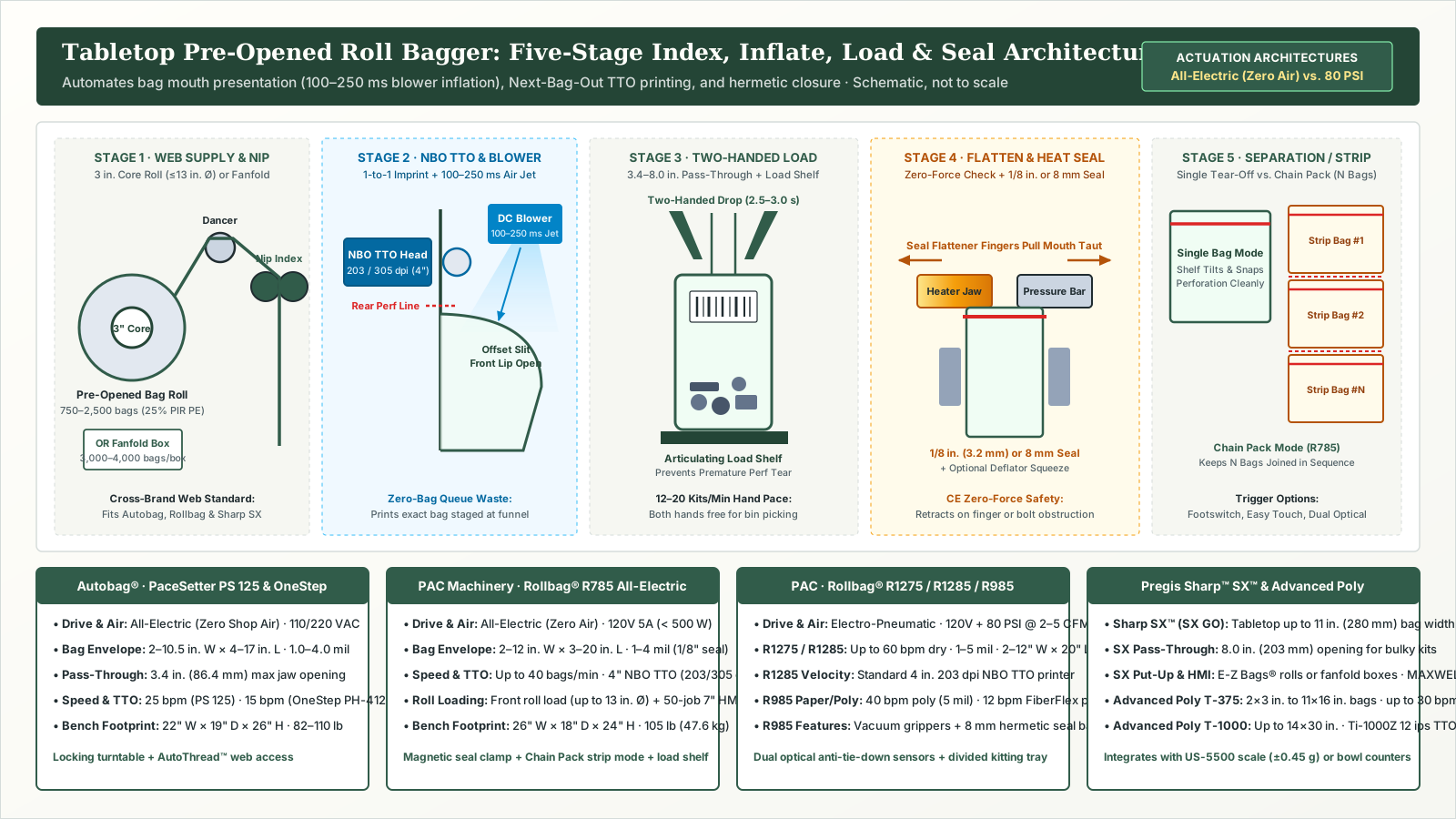
A tabletop bagging machine feeds pre-opened bags wound on a 3 in. (76 mm) core or fanfolded in a box, snaps each bag mouth open in 100 to 250 ms using an internal DC blower stream directed at the offset slit front lip, holds the throat open (3.4 to 8.0 in. pass-through depth) for two-handed loading, and seals and separates the completed pack in 1.0 s. Select an all-electric model (110–240 VAC, zero compressed air, such as the Sealed Air Autobag PaceSetter PS 125 or PAC Machinery Rollbag R785) for plug-and-play benches without shop air drops, select an electro-pneumatic model (80 PSI @ 2–5 CFM, such as the Rollbag R1275, R1285 Velocity, or R985 Paper/Poly) when sealing 5 mil films, 75 lb curbside-recyclable paper bags, or cycling up to 60 bags/min, and specify inline Next-Bag-Out (NBO) thermal transfer overprinting (203 or 300/305 dpi) to eliminate label-queue scrap on short 1 to 500 kit runs.
| Workstation Parameter | Verified Tabletop OEM Envelope | Operational Impact at the Kitting Bench |
|---|---|---|
| Actuation & Utility Supply | All-Electric (Zero Air): 110/220 VAC, 5A, < 500 W (Autobag PS 125, Rollbag R785)Electro-Pneumatic: 120V, 7–7.5A + 80 PSI @ 2–5 CFM (5.5 bar @ 140 L/min, Rollbag R1275 / R1285 / R985) |
All-electric units deploy on mezzanine benches, cleanrooms, or 3PL pack tables without compressor drops; 80 PSI pneumatic models add clamp force for 5 mil poly and 75 lb paper bags. |
| Bag Width × Length Envelope | 2.0 to 10.5 in. W × 4.0 to 17.0 in. L (Autobag PS 125)2.0 to 12.0 in. W × 3.0 to 20.0 in. L (Rollbag R785 / R985 / R1285)Up to 14.0 × 30.0 in. (Advanced Poly T-1000) |
Covers hardware fastener packets (2 × 3 in.) through mid-size sub-assemblies and apparel mailers (12 × 20 in.) using standard 3 in. (76 mm) core roll bags or fanfold boxes. |
| Film Gauge & Seal Width | 1.0 to 4.0 mil (25–102 µm, PS 125 & R785); 1.0 to 5.0 mil (25–127 µm, R1275 / R1285 / R985); 1/8 in. (3.2 mm) poly seal or 8 mm paper/poly hermetic bar (R985) |
Matches standard 1.5–2.0 mil light hardware bags and 3.0–4.0 mil heavy puncture-resistant fastener kits; R985 runs FiberFlex paper up to 75 lb basis weight. |
| Maximum Pass-Through Depth | 3.4 in. (86.4 mm) (Autobag PS 125 / OneStep) up to 8.0 in. (203 mm) (Pregis Sharp SX / SX GO) |
Defines the thickest 3D component or boxed sub-assembly that can drop through the open pressure bar throat without jamming. |
| Dry Cycle vs. Hand-Load Rate | Machine ceiling: 15–25 bpm (PS 125), 30 bpm (T-375), 40 bpm (R785 / R985), 60 bpm (R1275 / R1285)Sustained 1-operator hand kitting: 12–20 kits/min (3.0–5.0 s/kit) |
Machine indexing (1.0 s) overlaps operator bin picking (2.5–3.5 s), tripling single-operator output compared with loose flat polybags (4–6 kits/min). |
Inline Next-Bag-Out (NBO) TTO |
4.0 in. (102–104 mm) print width at 203 dpi (8 dots/mm) or 300–305 dpi (12 dots/mm), up to 10–12 in./s (254–300 mm/s) |
Prints barcodes, part numbers, and revision text directly onto the exact bag staged at the funnel—zero 3-to-5 bag web queue waste and zero $0.015–$0.030 paper label cost. |
Compare all-electric and pneumatic tabletop pre-opened roll baggers
In our small-parts bagging workstation trial guide, evaluating a hand-loaded bagger is deliberately separated from evaluating vibratory bowl counters or multi-conveyor infeeds so engineering teams can verify whether bag presentation, labeling, and closure is the actual bench constraint. Across high-mix hardware kitting, electronics sub-assemblies, medical device packaging, and short-run fulfillment (orders of 25 to 500 kits within the kitting equipment scope), floor-standing industrial baggers—such as the 293 lb (133 kg) Pregis Sharp™ MAX-12 (measuring 39.7 × 45.3 × 40.1–46.3 in.) or floor-mounted Autobag 500/600 systems—frequently fail benchtop integration for two physical reasons:
- Plumbed Compressed Air Dependency (
80 PSI @ 3–5 SCFM): Floor-standing baggers and high-speed pneumatic units require clean, dry compressed air (5.5 bar / 80 PSI) to drive their sealing cylinders, load shelves, and bag deflators. Packing benches positioned on warehouse mezzanines, in R&D assembly rooms, or in flexible 3PL kitting cells rarely have overhead air drops, and running portable shop compressors next to operators introduces unacceptable noise (> 78 dBA) and moisture condensation. - Floor Footprint and Rear Roll-Loading Clearance: A
40 × 45 in.floor frame with a rear-cantilevered unwind mandrel cannot sit on an existing30 × 60 in.(762 × 1,524 mm) kitting workbench surrounded by gravity flow racks.
A tabletop bagging machine (pre opened roll bagger or tabletop autobag style bagger) condenses the entire unwind, nip-index, blower-inflate, thermal-transfer-imprint, heat-seal, and perforation-tear mechanism into a 75 to 110 lb (34 to 50 kg) chassis occupying 22 × 19 in. to 30 × 30 in. (559 × 483 mm to 762 × 762 mm) of bench area. Unlike a continuous rotary band sealer machine—which only closes the top of a loose pouch that an operator has already pulled from a stack, pried open by hand, and filled upstream—a tabletop pre-opened roll bagger automates bag presentation and mouth opening prior to loading.
Across primary manufacturers, tabletop roll baggers divide into two mechanical actuation architectures:
1. Architecture A — All-Electric Plug-and-Play Tabletop Baggers (Zero Compressed Air)
Designed specifically for quiet, portable workstation deployment where only a standard 110–120 VAC (or 220–240 VAC) wall outlet is available:
- Sealed Air Autobag® PaceSetter PS 125 & PS 125 OneStep: Weighs
82 lb(37 kg) in standard form (110 lb / 50 kgfor thePS 125 OneStepwith integrated imprinter) inside a22 in. W × 19 in. D × 26 in. H(56 × 48 × 66 cm) footprint. Operates on switchable110/220 VAC(50/60 Hz,5.0 / 2.0 A) with zero compressed air. Handles pre-opened bags on a roll from2.0 to 10.5 in.(51–267 mm) wide and4.0 to 17.0 in.(102–432 mm) long in1.0 to 4.0 mil(25–102 µm) film thickness, providing a3.4 in.(86.4 mm) maximum pass-through jaw opening and cycling at up to25 bags/min(15 bags/minon thePS 125 OneStep). To solve rear-access bench constraints, thePS 125mounts on a locking turntable withAutoThread™web access so the operator spins the machine on the tabletop to load a fresh bag roll or thread thermal transfer ribbon. - PAC Machinery Rollbag® R785 All-Electric: Weighs
105 lb(47.6 kgshipping /35 kgnet) in a26 in. W × 18 in. D × 24 in. H(660 × 457 × 610 mm) frame powered by120V, 5A, 50/60 Hz(< 500 Wpower draw;220Voptional) with zero compressed air. Instead of a pneumatic cylinder, theR785closes its pressure bar under low, CE-compliant stepper force (zero-force obstruction sensing) and engages a high-power electromagnetic seal clamp paired with a ceramic heating element to form a1/8 in.(3.2 mm) wide heat seal across1.0 to 4.0 mil(25–100 µm) polyethylene bags from2.0 to 12.0 in.(50–305 mm) wide by3.0 to 20.0 in.(76–508 mm) long at speeds up to40 bags/min. Crucially for tight benches, bag rolls up to13 in.(330 mm) in diameter load directly from the front of the machine, and standard hardware includes a7 in.(50-job) color touchscreen HMI, opposing seal flattener fingers, an adjustable articulating bottom load shelf, andChain Packconnected-strip bagging mode.
2. Architecture B — Electro-Pneumatic High-Speed & Dual-Material Tabletop Baggers (80 PSI @ 2–5 CFM)
When a workstation has a plumbed 80 PSI (5.5 bar) compressed air line delivering 2 to 5 CFM (56 to 140 L/min), pneumatic actuation unlocks 60 bags/min dry-cycle speeds, higher jaw clamp force for 5.0 mil (127 µm) industrial poly or heavy paper bags, and pneumatic bag-control attachments:
- PAC Machinery Rollbag® R1275 &
Rollbag® R1285 Velocity: Cycle at up to60 bags/min(dry cycle) across1.0 to 5.0 mil(25–127 µm) film thickness using120V, 7Aelectrical power plus80 PSI @ 2–5 CFMcompressed air. TheR1275(26 × 28 × 22 in.,75 lb / 35 kg) runs2 to 10 in.(50–304 mm) wide by3 to 20 in.(76–508 mm) long bags with dancing-roller web tensioning, a20-jobPLC touchscreen, optional dual optical anti-tie-down hand start sensors, and an optional overhead stainless kitting/sorting tray with dividers. TheR1285 Velocity(30 × 30 × 24 in.,85 lb) expands width capacity to2 to 12 in.(50–305 mm) (4 to 20 in.length) and includes a standard4 in.203 dpiFirst-Bag-Out / Next-Bag-Out thermal transfer printer for e-commerce and fulfillment cells. - PAC Machinery Rollbag® R985 Tabletop Paper or Poly Bagger: A dual-material electro-pneumatic tabletop bagger (
26 × 24 × 24 in.,75 lb / 34 kg,120V 7.5A < 1,000 W+80 PSI @ 5 CFM) engineered for operations transitioning hardware kits from polyethylene to curbside-recyclable paper. TheR985runs pre-opened polyethylene bags up to12 × 20 in.(up to 5 milthickness at40 bags/min) andFiberFlexpre-opened recyclable paper bags up to11 × 20 in.(up to 75 lbpaper basis weight at12 bags/min) from either3 in.core rolls or fanfolded boxes. Because heavy kraft paper does not balloon open as easily as thin1.5 milLDPE film under air alone, theR985combines its blower stream with pneumatic vacuum grippers that physically pull the paper bag mouth open, and seals the pouch with an8 mmwide hermetic heat-seal bar (with an optional 1.5 mm / 1/16 in. seal bar dedicated to PE film). - Pregis Sharp™ SX™ (
SX GO) Tabletop & Advanced Poly-PackagingT-375 / T-1000: The Pregis Sharp SX™ (SX GO) accommodatesE-Z Bags®(on rolls or fanfolded in boxes) from2.0 to 11.0 in.(50–280 mm) wide with an extra-deep8.0 in.(203 mm) pass-through opening for bulky hardware boxes or plumbing fittings, controlled via theMAXWELLdiagnostic touchscreen with an integrated4 in.thermal transfer printer. Advanced Poly-Packaging’sT-375(2 × 3 in.to11 × 16 in.bags, up to30 bags/min) andT-1000(2 × 3 in.to14 × 30 in./356 × 762 mmbags, up to60 bags/minwith optionalTi-1000Z12 in./sTTO imprinter) extend tabletop roll bagging to extra-long profiles and direct integration withUS-5500net-weight scales (±0.45 gweighment accuracy) or vibratory bowl counters.
OEM Benchmark Comparison Table: Tabletop Pre-Opened Roll Baggers
| OEM & Model Series | Drive Architecture & Utilities | Bag Width × Length, Film Gauge & Pass-Through | Cycle Speed & Integrated TTO Printer | Bench Footprint, Weight & Mechanical Highlights |
|---|---|---|---|---|
Sealed Air / Autobag®PaceSetter PS 125 & PS 125 OneStep |
All-Electric (Zero Air)110/220 VAC switchable, 50/60 Hz, 5.0 / 2.0 A |
2 – 10.5 in. W × 4 – 17 in. L( 51–267 × 102–432 mm);1.0–4.0 mil (25–102 µm);3.4 in. (86.4 mm) pass-through |
Up to 25 bags/min (PS 125);15 bags/min (PS 125 OneStep with built-in AutoLabel PH-412 Next-Bag-Out TTO) |
22" W × 19" D × 26" H (56 × 48 × 66 cm);82 lb (37 kg) / 110 lb (50 kg OneStep);Locking turntable + AutoThread™; job recall |
PAC MachineryRollbag® R785 All-Electric |
All-Electric (Zero Air)120V, 5A, 50/60 Hz (< 500 W; 220V option); magnetic seal clamp |
2 – 12 in. W × 3 – 20 in. L( 50–305 × 76–508 mm);1.0–4.0 mil (25–100 µm);1/8 in. (3.2 mm) seal; 13 in. max roll Ø |
Up to 40 bags/min;Optional integrated 4 in. Next-Bag-Out TTO (203 / 305 dpi) or 4 in. direct-thermal labeler |
26" W × 18" D × 24" H (660 × 457 × 610 mm);105 lb (35–47.6 kg); Front roll loading; 50-job 7" HMI; flattener fingers; load shelf; Chain Pack strip mode |
PAC MachineryRollbag® R1275 & R1285 Velocity |
Electro-Pneumatic120V, 7A, 50/60 Hz +80 PSI @ 2–5 CFM (5.5 bar @ 140 L/min) |
R1275: 2–10" W × 3–20" LR1285: 2–12" W × 4–20" L1.0–5.0 mil (25–127 µm);1/8 in. (3.2 mm) seal width |
Up to 60 bags/min (dry cycle);R1285 includes standard 4 in. 203 dpi Next-Bag-Out TTO (203/300 dpi at 10–12 ips on R1275) |
R1275: 26" W × 28" D × 22" H (75 lb / 35 kg)R1285: 30" W × 30" D × 24" H (85 lb);20-job PLC; dancing roller; optional sorting table & dual optical start sensors |
PAC MachineryRollbag® R985 Paper or Poly |
Electro-Pneumatic120V, 7.5A, 60 Hz (< 1,000 W) +80 PSI @ 5 CFM |
Poly: up to 12" W × 20" L (5 mil)Paper ( FiberFlex): up to 11" W × 20" L (75 lb weight);8 mm seal (1.5 mm PE option) |
Up to 40 bags/min (Poly)Up to 12 bags/min (Paper);Optional 4 in. (203/305 dpi) Next-Bag-Out TTO or labeler |
26" W × 24" D × 24" H (660 × 610 × 610 mm);75 lb (34 kg); Vacuum grippers hold paper/poly bags open; runs roll bags or fanfold boxes; 50-job HMI |
Pregis Sharp™SX™ (SX GO) Tabletop (vs. Floor MAX-12) |
SX GO: Compact tabletop;(vs. MAX-12 floor stand requiring 80 PSI @ 5 SCFM) |
SX GO: 2 – 11 in. W (E-Z Bags® roll or fanfold box) with 8.0 in. (203 mm) pass-through depth;( MAX-12: 2–12" W × 3.5–32" L, 1.2–6.0 mil) |
High-speed hand/semi-auto pacing (up to 50 bpm on MAX-12);Integrated 4 in. thermal transfer printer |
Compact tabletop (vs. 293 lb / 39.7×45.3" MAX-12);MAXWELL diagnostic touchscreen HMI; handles fanfolded bags in a box for 3×–4× longer runs |
Advanced Poly-PackagingT-375 & T-1000 Tabletop |
Tabletop pre-opened roll baggers (110–120 VAC + shop air depending on sealer/imprinter) |
T-375: 2 × 3 in. to 11 × 16 in. (51×76 to 279×406 mm);T-1000: 2 × 3 in. to 14 × 30 in. (356×762 mm) |
Up to 30 bags/min (T-375) to 60 bags/min (T-1000);Optional Ti-1000Z TTO (12 in./s) |
Tabletop frame; integrates with US-5500 net-weight scale (±0.45 g tolerance) or vibratory bowl counters |
How pre-opened bags on a roll inflate, support heavy kits, and cut unit cost
Why can an operator load a pre opened roll bagger three to four times faster than picking up a loose flat polybag at a manual bench? The speed gain comes from the converting geometry of the consumable web—known across the packaging industry as Autobag-style pre-opened bags on a roll, Rollbag bags, or Sharp E-Z Bags®—and its five-stage mechanical interaction with the bagger throat.
1. Pre-Opened Web Converting Geometry (3 in. Core Rolls vs. Fanfolded Boxes)
During tubular blown-film converting, each bag in the continuous web is bottom-sealed across the tube width and separated from the trailing bag by two aligned features:
- Rear Wall Transverse Perforation: The back ply of the tube is punched with a toothed transverse perforation line (
calibrated to hold together under web tension during nip indexing while snapping cleanly when the sealed bag is pulled or tilted). - Front Wall Offset Slit Lip (
Pre-Opened Mouth): Immediately below the bottom heat seal of the preceding bag, the front ply of the film is slit completely through from edge to edge.
As documented by PAC Machinery’s Converting Technology division and Packaging Digest, pre-opened bags wound on standard 3 in. (76 mm) inner cores (up to 13 in. / 330 mm outer roll diameter) or fanfolded in rectangular corrugated boxes are mechanically interchangeable across Sealed Air Autobag (PS 125, 500/550/600), PAC Machinery Rollbag (R785, R985, R1275, R1285, R3200), and Pregis Sharp (SX, MAX-12, MAX-20) machines, and are extruded as standard with 25% post-industrial recycled (PIR) polyethylene at price parity with virgin LDPE/LLDPE.
2. Five-Stage Mechanical Cycle at the Loading Throat
- Stage 1 — Dancer-Tensioned Nip Indexing: Driven elastomer nip rollers advance the web over a dancer bar (
Rollbag R1275) or front-load guide path (Rollbag R785/Autobag AutoThread™) until an optical registration sensor or encoder detects the perforation/print mark for the programmed bag length (3.0 to 20.0 in./76 to 508 mm). The nip stops with the rear perforation held captive0.5 to 0.75 in.(12–19 mm) above the open sealing jaws and the slit front lip positioned directly below the nip. - Stage 2 — Directed Air-Stream Mouth Inflation (
100 to 250 ms): An internal continuous or gated DC blower fan directs a downward air jet right at the exposed slit front lip (assisted by pneumatic vacuum grippers on the paper/poly Rollbag R985). Within100 to 250 milliseconds, the front ply balloons outward against the front pressure bar/funnel plates, creating a rigid, wide-open target (up to 3.4 in. / 86.4 mm deep on the Autobag PS 125 or 8.0 in. / 203 mm on the Pregis Sharp SX) before the operator’s hands finish picking the next set of parts. - Stage 3 — Articulating Bottom Load Shelf & Air Expeller (
Deflator): When an operator drops0.25 to 2.5 kg(0.55 to 5.5 lb) of steel bolts, bearings, or brass fittings into an open polybag suspended only by its rear top perforation, kinetic impact can rip the perforation prematurely before sealing. To prevent premature tear-off, tabletop baggers such as theRollbag R785,R985,R1275, andR1285position an adjustable articulating bottom load shelf directly under the inflated bag base to carry the hardware weight during loading. When the cycle is triggered, an optional air expeller (bag deflator) squeezes excess trapped air out of the bag body (avoiding the need for pre-punched vent holes when moisture or dust protection is required), while opposing seal flattener fingers spread the top mouth laterally taut so no film fold crosses the seal line. - Stage 4 — Zero-Force Obstruction Check & Hermetic Top Seal: The front pressure bar closes under low stepper/servo or regulated force; if the bar contacts an operator finger or a protruding fastener (
obstruction sensing), it immediately retracts without applying clamping force. Once fully closed, the electromagnetic clamp (R785) or pneumatic cylinder (R1275 / R1285 / R985) locks the jaw and fires the heater element (1/8 in. / 3.2 mm seal across 1–5 mil poly, or 8 mm wide seal bar on R985). - Stage 5 — Perforation Tear-Off vs.
Chain PackConnected Strip Mode: In standard single-bag mode, the bottom load shelf tilts downward (or the nip rollers execute a brief reverse-pull twitch while the seal jaws clamp the web), snapping the rear transverse perforation cleanly so the sealed kit drops into an outfeed tote while the next bag blows open immediately. InChain Packstrip mode (available on the PAC Machinery Rollbag R785), the operator enters a strip quantityNon the7 in.touchscreen HMI; the bagger seals and indexesN − 1bags without snapping the perforation, separating only after theNth bag so sequential assembly steps, hardware sub-kits, or retail strip packs remain connected in order.
Comparison of Four Kitting Bag Formats (Loose Flat vs. Roll vs. Fanfold vs. Tubing)
| Consumable Format & Presentation | Typical Unit Cost & Put-Up Count | Operator Hand Motions & Sustained Rate | Reload Interval & Best Workstation Application |
|---|---|---|---|
| 1. Loose Flat Polybags + Bench Impulse Sealer (Manual ply separation + stationary impulse jaw) |
$0.008 – $0.015 / bag( Bulk carton of 1,000–5,000 loose flat LDPE bags) |
6 manual motions (10 – 15 s / bag)Sustained: 4 – 6 kits/min (240 – 360 kits/hr) |
No web threading; suited only for ultra-low volume (< 100–150 kits/day) or oversized odd bags (> 14 × 30 in.). |
2. Pre-Opened Bags on a Roll (3 in. Core)( Autobag, Rollbag, Sharp E-Z Bags®) |
$0.016 – $0.032 / bag( 750 – 2,500 bags/roll, up to 13 in. outer roll Ø on R785) |
1–2 motions (3.0 – 5.0 s / bag)Sustained hand-load: 12 – 20 kits/min (720 – 1,200 kits/hr; machine cap 25–60 bpm) |
60–90 s front/turntable reload every 750–2,500 kits; primary standard for high-mix benchtop kitting (150–4,000+ kits/day). |
| 3. Fanfolded Pre-Opened Bags in a Box ( Autobag-style fanfold case on R985, Sharp SX, R3200) |
$0.016 – $0.034 / bag( 3,000 – 4,000 bags/box vs. 750–1,000/roll for 8×11 to 10×13 in. 2.5 mil) |
Identical 3.0 – 5.0 s / bag( 12 – 20 kits/min hand-load; up to 40–60 bpm auto) |
3× to 4× longer run between reloads (cuts roll changeovers by 75%); rectangular boxes stack denser on pallets than round rolls. |
4. Layflat Poly Tubing (Inline Form-Fill-Seal)(Floor-standing Rollbag R3200 / Clamco) |
$0.009 – $0.018 / bag( Continuous layflat polyethylene tube roll; cuts custom bag length inline) |
Requires bottom-seal + top-seal cut cycle (typically floor-standing automatic lines) |
High-volume runs or variable-length extrusions/profiles where stocking pre-opened bags across many lengths is impractical. |
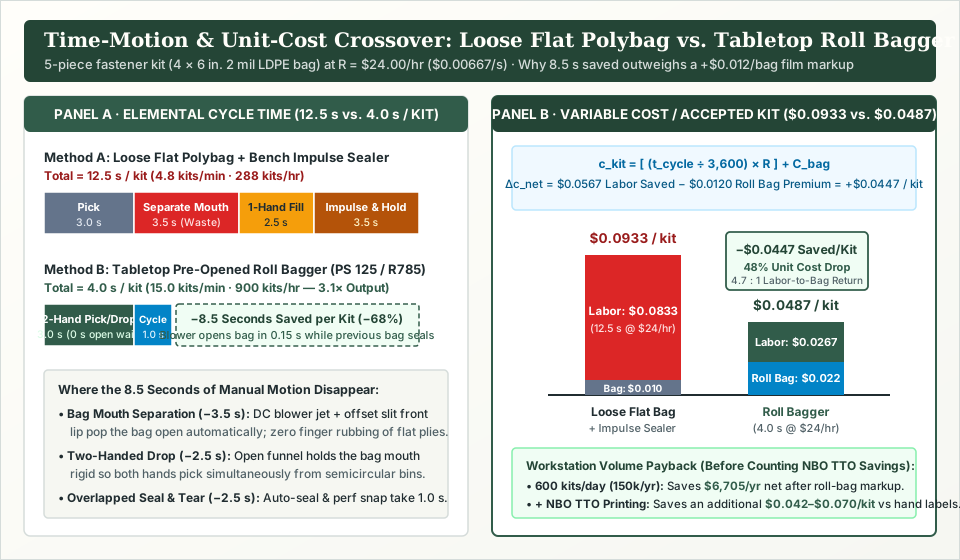
Worked Time-Motion & Unit-Cost Crossover Math: Why 8.5 Seconds Saved Beats a +$0.012/Bag Film Markup
A common purchasing objection is that pre-opened bags on a roll cost $0.010 to $0.017 more per piece than bulk loose flat polybags because of tubular perforation and slit-lip converting. Applying the job-cost equation from our kitting cost model (Cost per accepted kit = (H × R + V + F) ÷ G) alongside the stationary-jaw cycle equation from our impulse heat sealer guide quantifies the exact trade-off between consumable price and operator labor:
Elemental Cycle Time & Per-Kit Variable Cost Crossover Equations:

  Loose Flat Polybag + Bench Impulse Sealer Cycle Time (t_loose [s]):
    t_loose = t_pick_1hand + t_separate_mouth + t_hold_and_funnel + t_impulse_seal_hold

  Tabletop Pre-Opened Roll Bagger Cycle Time (t_roll [s]):
    t_roll  = t_pick_2hand_drop + t_trigger_index_seal
              (where 0.15–0.25 s blower mouth inflation overlaps picking)

  Variable Cost per Accepted Kit (Labor + Bag Consumable):
    c_loose [$/kit] = [ (t_loose ÷ 3,600) × R ] + C_bag,loose
    c_roll  [$/kit] = [ (t_roll  ÷ 3,600) × R ] + C_bag,roll

  Net Variable Savings per Accepted Kit (Δc_net [$/kit]):
    Δc_net = c_loose − c_roll
           = [ ((t_loose − t_roll) ÷ 3,600) × R ] − (C_bag,roll − C_bag,loose)

  Break-Even Hourly Labor Rate Where Roll Bag Markup Is Fully Offset (R_breakeven [$/hr]):
    R_breakeven = [ 3,600 × (C_bag,roll − C_bag,loose) ] ÷ (t_loose − t_roll)
Consider a standard 4 × 6 in. (102 × 152 mm) 2.0 mil hardware fastener kit containing 5 pieces hand-picked from benchtop gravity bins (workstation planning benchmark):
- Method A — Loose Flat Polybag + Bench Impulse Sealer (
t_loose = 12.5 s/kit=4.8 kits/min=288 kits/hr):- Pick
5fasteners from bins:3.0 s - Pull one flat bag from the stack and pinch/rub the static-clung polyethylene plies between thumb and forefinger to open the mouth:
3.5 s - Hold the limp bag mouth open with the left hand while funneling parts in with the right hand:
2.5 s - Carry the filled bag to the stationary impulse sealer jaw, flatten the neck, press the pedal, wait
1.0 spowered heating +1.0 sclosed-jaw cooling hold (per impulse sealer congealing requirements), and drop into the tote:3.5 s - Total manual cycle (
t_loose):12.5 s / accepted kit(0.2083 min/kit).
- Pick
- Method B — Tabletop Pre-Opened Roll Bagger (
Autobag PS 125orRollbag R785,t_roll = 4.0 s/kit=15.0 kits/min=900 kits/hr):- While the previous bag seals and snaps its perforation, the internal DC blower has already inflated the next bag mouth wide open below the funnel (
0.0 soperator waiting time). - With both hands completely free, the operator picks
5fasteners symmetrically from a semicircular bin arc (2.5 s) and drops them straight through the open funnel onto the articulating load shelf (0.5 s):3.0 s - Operator taps the pressure bar / footswitch (
or passes both hands through the optical start sensors), and the machine seals, separates, and inflates the next bag:1.0 s - Total roll-bagger cycle (
t_roll):4.0 s / accepted kit(0.0667 min/kit)—saving8.5 seconds per kit(68%labor time reduction) and increasing single-operator bench output3.1×(from 288 to 900 kits/hr).
- While the previous bag seals and snaps its perforation, the internal DC blower has already inflated the next bag mouth wide open below the funnel (
- Unit-Cost Crossover at
R = $24.00/hr($0.00667 / second),C_bag,loose = $0.010, andC_bag,roll = $0.022(+$0.012/bagmarkup):- Loose Flat Bag + Impulse Sealer (
c_loose):c_loose = (12.5 s × $0.00667/s) + $0.0100 = $0.0833 (labor) + $0.0100 (bag) = $0.0933 / accepted kit - Tabletop Pre-Opened Roll Bagger (
c_roll):c_roll = (4.0 s × $0.00667/s) + $0.0220 = $0.0267 (labor) + $0.0220 (bag) = $0.0487 / accepted kit - Net Savings per Accepted Kit (
Δc_net):Δc_net = $0.0567 (labor saved) − $0.0120 (roll bag premium) = $0.0447 saved per accepted kit (48% unit cost reduction) - Labor-to-Consumable Return Ratio: Every
$0.0120spent on the pre-opened roll bag converting feature returns$0.0567in direct operator labor savings (a 4.7 : 1 return). Even if burdened labor were as low asR_breakeven = (3,600 × $0.012) ÷ 8.5 s = $5.08/hr, the roll bagger would still break even on variable cost. Across a single workstation packing600 kits/day(150,000 kits/year), the net variable saving is$6,705/year(or $11,175/year at 1,000 kits/day)—before adding the+$0.042 to +$0.070/kitsaved by replacing offline pressure-sensitive labels with inline Next-Bag-Out thermal transfer printing.
- Loose Flat Bag + Impulse Sealer (
Eliminate label-queue waste with Next-Bag-Out thermal transfer overprinting
In high-mix hardware kitting, medical device assembly, and e-commerce order fulfillment, nearly every sealed bag requires a SKU part number, engineering revision level, date/lot code, GS1/UPC/FNSKU barcode, or customer shipping identification (see kitting quality control checks and semi-automatic labeling workstations). Small-batch benches that separate bag printing from bag loading encounter three costly bottlenecks:
- Pre-Printed Custom Roll Bags: Require high minimum order quantities (
MOQs), tie up warehouse shelf space per SKU, create obsolete film scrap whenever a BOM revision changes, and force a60–90 sroll changeover between every short order. - Offline Pressure-Sensitive Paper/Poly Labels (
Applied by Hand or Bench Applicator): A thermal-transfer pressure-sensitive label on siliconized release liner adds$0.015 to $0.030 per labelin consumable cost plus4.0 to 6.0 secondsof manual handling per bag (peeling, aligning on a flexible bag face without wrinkles, and wiping down—costing an additional $0.027 to $0.040/bag in labor at $24.00/hr). In addition, sticking a paper label onto an LDPE bag contaminates mono-material polyethylene recycling streams. - Legacy “Upstream Queue” Thermal Imprinting (
3 to 5 Bag Pitches Back): First-generation automatic baggers mounted their thermal transfer printhead along the rear unwind dancer path3 to 5 bag lengths upstreamof the loading funnel. Whenever a20-pieceorder finished or an operator scanned a new warehouse order traveler, the3 to 5bags already threaded between the printhead and the sealing jaws had to be indexed and scrapped (or buffered in rigid multi-bag batch queues), making batch-of-one (q = 1) or ultra-short kitting runs wasteful.
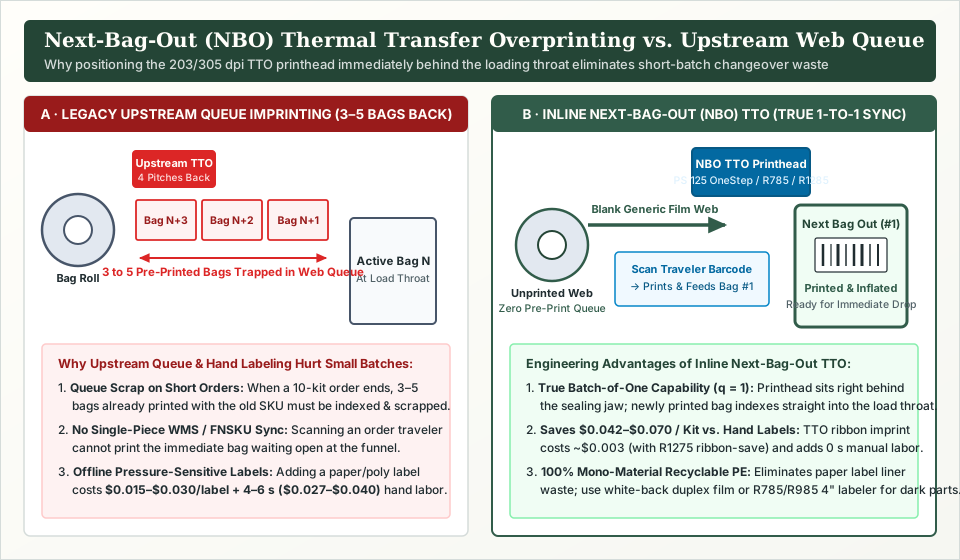
How Inline Next-Bag-Out (NBO) Thermal Transfer Overprinting (TTO) Works
Modern tabletop roll baggers—specifically the Sealed Air Autobag® PaceSetter PS 125 OneStep (AutoLabel™ PH-412 imprinter), the PAC Machinery Rollbag® R785 with Integrated 4 in. NBO Printer, the Rollbag® R1285 Velocity (First-Bag-Out / Next-Bag-Out 203 dpi TTO), the Rollbag® R1275 (203 / 300 dpi TTO), and the Pregis Sharp™ SX™ (SX GO)—mount a 4.0 in. (102–104 mm / 4.09 in.) wide thermal transfer printhead (203 dpi / 8 dots/mm or 300–305 dpi / 12 dots/mm) immediately behind the bag currently staged at the loading throat:
- Zero-Bag Queue (
True 1-to-1 Order Synchronization): When the operator scans the barcode on the order traveler (or scans a WMS pick ticket / Amazon FNSKU barcode), the TTO printhead transfers wax/resin or full-resin ribbon ink directly onto the unprinted generic polybag (at up to 10–12 in./s / 254–300 mm/s on the Rollbag R1275 or Advanced Poly Ti-1000Z), and the nip rollers immediately index that exact printed bag (Bag #1) into the loading funnel and blow it open. There is zero3-to-5 bagweb offset queue and zero wasted film when switching from a1-piecespare-part kit to a35-piecefastener kit. - Combined Label + Labor Savings (
+$0.042 to +$0.070 Saved per Kit): Overprinting directly onto the bag web with a thermal transfer ribbon (using the built-in ribbon-saving mode on the Rollbag R1275, which advances ribbon only across the active print height at a consumable cost of~$0.002 to $0.004 / imprint) eliminates both the$0.015–$0.030pressure-sensitive label and the4.0–6.0 s($0.027–$0.040) manual labeling motion, while keeping the polyethylene bag100%mono-material recyclable (with tilt-back printhead access on the Autobag PS 125 OneStep PH-412 for rapid ribbon maintenance). - Clear Film vs. White-Back Duplex Film vs. Integrated
4 in.Label Applicator (R785 / R985):- 1D/2D Barcode Contrast Rule: Barcode scanners require a light background behind dark thermal-transfer bars (
quiet zone reflectance). When bagging dark oxide bolts or visually busy hardware, specify white-back / clear-front (duplex) pre-opened roll bags or clear bags with a pre-printed white write-on/print block so the203or305 dpiTTO imprint has high contrast while the clear front ply still allows full visual inspection of the parts. - When to Specify the Integrated Direct-Thermal Label Applicator Option: If a customer specification requires
100%clear unprinted film across both sides of the bag (or if a facility runs dark poly mailers), PAC Machinery’s Rollbag R785 and R985 offer an integrated4 in.Next-Bag-Out direct-thermal label printer-applicator as a factory alternative to direct-on-film TTO, automatically printing and tamping an opaque white label onto the next bag as it indexes into the loading position.
- 1D/2D Barcode Contrast Rule: Barcode scanners require a light background behind dark thermal-transfer bars (
Configure the hand-kitting bench, trigger safety, and first-piece record
A tabletop roll bagger rated at 25 to 60 bags/min will still produce only 6 to 8 kits/min—or generate unaccepted seal defects—if the surrounding bench bins force long reach motions, if heavy kits tear the perforation before jaw closure, or if an auto-pacing timer rushes the operator into sealing an incomplete kit. Configure the workstation around these four engineering rules within your small-batch packaging and kitting quality control workflow:
1. Semicircular Two-Handed Bin Arc & Overhead Divided Kitting Tray (14 to 18 in. Reach)
To achieve a 2.5 to 3.0 s pick-and-drop motion, arrange gravity-fed component bins in a semicircular arc within 14 to 18 in. (355 to 457 mm) of the bagger loading throat so the operator’s left and right hands pick components simultaneously without trunk rotation.
- Overhead Sorting & Visual Count Verification Tray (
Rollbag R1275): When kits contain6 to 15distinct fasteners where visual count verification must occur before parts enter the bag, equip the bagger with an overhead stainless steel kitting/sorting table with adjustable dividers (documented on thePAC Machinery Rollbag R1275). The operator stages the components into the divided tray slots directly above the adjustable loading funnel, verifies that every compartment is filled, and sweeps the complete kit down through the funnel into the inflated bag mouth in one motion.
2. Ergonomic Sit-Stand Throat Height (22 to 36.5 in.) & Front/Turntable Roll Access
Mount the tabletop bagger so the top of the open bag mouth sits 2 to 4 in. (50 to 100 mm) below the standing or seated operator’s bent elbow:
- Dedicated Adjustable Utility Stands: Rather than placing a
24 to 26 in.tall bagger on top of a fixed36 in.shipping table (which pushes the loading funnel up to 60 in. / 1,524 mm shoulder height), use an adjustable equipment stand—such as PAC Machinery’s Rollbag R785 utility stand (adjusting from 27.5 to 36.5 in. / 699 to 927 mm floor-to-support height with lockable casters) or the motorized push-button height stand (adjusting from 22 to 34 in. / 559 to 864 mmon theR785,R1275, andR1285). - Clearance for Roll Reloads (
< 90 s): Preserve front clearance for front-loading13 in.rolls on theRollbag R785, side/turntable rotation clearance for theAutobag PS 125locking turntable, or under-table floor space for3,000–4,000 bagfanfold boxes on theRollbag R985andPregis Sharp SX.
3. Selecting the Cycle Trigger Mode (Footswitch vs. Easy Touch vs. Dual Optical vs. Auto-Pace)
Tabletop pre-opened roll baggers provide four distinct cycle initiation modes. Match the trigger mode to the cognitive complexity of the kit:
| Cycle Trigger Mode | Supported OEM Models | How It Operates at the Bench | When to Use vs. When to Avoid |
|---|---|---|---|
| 1. Electric Footswitch (Standard on PS 125, R785, R985, R1275, R1285) |
All models | Operator presses guarded foot pedal after dropping parts and visually confirming all pieces settled below the seal zone. | Best default for multi-part hardware kits (3–12 pieces) where pick times vary from cycle to cycle. |
2. Push-to-Seal Pressure Bar / Magnetic Easy Touch Sensor |
Autobag PS 125, Rollbag R785 (Easy Touch magnetic button) |
Operator’s downward hand motion lightly taps the pressure bar or a portable magnetic touch switch positioned beside the funnel rim. | Best for standing operators to eliminate one-legged foot-pedal posture fatigue over an 8-hour shift. |
| 3. Dual Optical Anti-Tie-Down Hand Sensors | Rollbag R1275, Rollbag R1285 Velocity |
Two no-touch optical beams flank the loading zone; both hands must break both beams simultaneously to initiate jaw closure. | Best for high-speed 15–25 kit/min two-handed drops; physically guarantees neither hand is inside the bag throat during sealing. |
4. Automatic Pacing Timer (Auto-Cycle Dwell) |
PS 125, R785, R985, R1275, R1285, Sharp SX |
Machine indexes, inflates bag, waits a preset dwell (e.g., 2.0–6.0 s), and closes jaws automatically. |
Use ONLY for simple 1-piece drops or automated counter/scale feeds. Avoid on multi-part hand kits (causes operators to rush incomplete kits into closing jaws). |
Copyable Tabletop Pre-Opened Roll Bagger Setup & First-Piece Qualification Record
Include these four verification gates on the warehouse order traveler whenever setting up a new kit SKU, changing roll width/gauge, or qualifying a first piece:
| Qualification Gate | Workstation Parameters to Record | Acceptance Criterion & Threshold Stop Rule |
|---|---|---|
| 1. Bag Envelope, Pass-Through & Headspace Datum | Roll or fanfold SKU (width × length in. / mm, 1.0–5.0 mil gauge or 75 lb FiberFlex paper), max 3D kit bulk vs. jaw pass-through (3.4 in. on PS 125 to 8.0 in. on Sharp SX), and measured empty film above settled parts (in. / mm) |
Gate: Assembled hardware drops cleanly through the open throat and settles on the articulating load shelf with ≥ 1.5 to 2.5 in. (38–64 mm) of clear film headroom below the 1/8 in. (3.2 mm) or 8 mm seal bar. |
| 2. Blower Inflation, Load Shelf & Flattener Check | Blower air-damper angle, vacuum gripper engagement (R985), articulating bottom load shelf height/tilt, air expeller (deflator) stroke, and opposing seal flattener finger span |
Gate: 10 consecutive dry-cycle bags pop wide open within < 0.25 s of nip stop with zero missed front lips, zero top-seal fold wrinkles, and zero premature perforation tears under full kit weight. |
3. Next-Bag-Out (NBO) TTO Barcode & Revision Sync |
Recalled HMI job recipe (Jobs 1–50 on R785/R985; 1–20 on R1275/R1285), TTO resolution (203 vs. 300/305 dpi), ribbon-save status, and barcode scan check of Bag #1 against the order traveler |
Stop Rule: Verify that Bag #1 printed immediately after scanning the order traveler displays the exact active SKU/revision (true 1-to-1 NBO sync, zero queue offset) and scans cleanly before loading parts. |
| 4. Jaw Obstruction Safety, Seal Integrity & Chain Pack | Heater temperature (°F / °C), seal dwell timer (s), trigger mode (footswitch / Easy Touch / dual optical), low-pressure obstruction bounce-back check, and Chain Pack strip count (1 for discrete bags or N for connected strips on R785) |
Stop Rule: Verify that a test gauge block placed in the closing throat triggers immediate low-force jaw retraction; if any cooled trial seal shows a fold channel, burn-through, or ragged perforation tear, stop and adjust flattener fingers or dwell before releasing the batch. |
Technical basis and scope
Machine specifications, utility requirements, bag size envelopes, pass-through clearances, and integrated printing architectures in this guide are grounded in primary technical documentation from PAC Machinery (Rollbag® R785 All-Electric Tabletop Automatic Bagger & Chain Pack Option, Rollbag® R1275 High-Speed Tabletop Bagger, Rollbag® R1285 Velocity Next-Bag-Out Bagger, Rollbag® R985 Tabletop Paper or Poly Bagger, and Converting Technology Autobag-Style Roll & Fanfold Bag Specifications), Sealed Air / Automated Packaging Systems & Pro Pac (Autobag® PaceSetter PS 125 and PS 125 OneStep Tabletop Baggers), Pregis Sharp Packaging Systems (Sharp™ SX™ / SX GO Tabletop and MAX-12 Roll Baggers), and Advanced Poly-Packaging, Inc. (T-375 & T-1000 Tabletop Baggers and Ti-1000Z Imprinter).
Elemental hand-motion cycle breakdowns (12.5 s/kit loose flat polybag vs. 4.0 s/kit tabletop pre-opened roll bagger) and the variable cost crossover model (c_kit = [(t ÷ 3,600) × R] + C_bag) apply industrial time-motion engineering to small-batch kitting cells. Substitute your facility’s burdened labor rate (R), consumable quotes (C_bag), and trial cycle times using our kitting cost worksheet and small-parts bagging trial protocol. Updated October 2026.