Transferring a speed or temperature setting onto a band sealer machine without calculating heater-bar dwell time and aligning conveyor throat height causes cold delamination on laminated pouches, 4-ply side-gusset channel leaks, scorched PTFE fiberglass belts, and unscheduled workstation downtime. Configuring a rotary band heat sealer for a high-mix kitting station requires matching horizontal versus vertical conveyor posture to the filled pouch state, scaling linear band speed against physical heating and cooling bar length, and verifying that batch quantity offsets thermal warm-up and height changeover time.
A band sealer machine increases workstation sealing throughput by separating operator hand-feed pace from thermal conduction and cooling hold time: two endless PTFE-coated fiberglass bands carry the pouch mouth continuously through stationary heated brass or alloy bars (127 to 381 mm long), nip compression wheels, and forced-air or vortex cooling bars (108 to 127 mm long). Select a horizontal conveyor (0° flat or 15°–30° inclined) when sealing dry hardware kits or flat pillow bags, select a vertical head (90° upright over a synchronized conveyor) when sealing stand-up Doypacks, powders, or liquids with at least 3.5 in. (88.9 mm) of free bag top, and calculate thermal dwell (t_dwell = 60 × L_heater ÷ v_band) before changing belt speed.
| Parameter or Workstation Variable | Verified OEM Specification Range | Operational Why It Matters at the Bench |
|---|---|---|
| Sealing Band Width | 6.35 mm (1/4 in., Emplex MPS / Fischbein SB & B2600), 8.0 mm (5/16 in., Audion D545), 11.1 mm (7/16 in., Audion D547 AHS & 555), up to 12.7 mm (1/2 in., B2600 option) |
Wider bands (8–12.7 mm) provide greater peel area across heavy gusseted pouches but require wider flat headspace above the product fill line. |
Heater Bar Zone Length (L_heater) |
Single zone: 5.0 in. (127 mm, Emplex MPS 6500), 6.0 in. (152.4 mm, Audion D547/555), 7.5 in. (190.5 mm, Doboy CBS-D 750); Dual zone: 10.0 in. (254 mm, MPS 7500), 14.38 in. (365.3 mm, Fischbein B2600), 15.0 in. (381 mm, Doboy CBS-D 1500) |
Determines conductive heating dwell time (t_dwell,heat = L_heater ÷ v_band). Doubling heater length allows 2× linear belt speed at identical film dwell. |
Cooling Bar Zone Length (L_cool) |
4.25 in. (108.0 mm, PAC Machinery Audion D545 / D547 AHS / 555) to 5.0 in. (127.0 mm, Plexpack Emplex MPS 6500 / 7500); forced-air or external vortex chilled (Saxon SB 2000) |
Solidifies molten sealant under band pressure before discharge so filled pouch weight does not cause hot-tack separation. |
Linear Band Speed (v_band) |
Tabletop & mid-range: up to 400 in./min (10.16 m/min / 33.3 ft/min, Audion D545/D547/555) or 240–552 in./min (20–46 ft/min, Saxon SB 1000/2000); Industrial: 1,000–1,200 in./min (25.4–30.5 m/min, Emplex MPS, Doboy CBS-D, Fischbein B2600) |
Governs residence time inside both heater and cooler blocks; must be synchronized with the bottom product conveyor (v_conveyor = v_band). |
| Throat Depth & Free Bag Top Datum | Max top-to-seal throat: 1.9 in. (48.3 mm, Audion D545), 2.75–3.5 in. (70–89 mm, Emplex MPS), 4.0 in. (101.6 mm extended header on Audion 555); Min free bag top above fill: ≥ 3.5 in. (88.9 mm, Fischbein Saxon SB 1000/2000) |
Prevents product bulk or powder from entering the heater nip and gives upright side gussets room to flatten cleanly without diagonal creasing. |
| Conveyor Load & Carrier-Belt Threshold | < 3 lb (1.36 kg, Syntegon Doboy CBS-D) supported by 12 mm (1/2 in.) urethane carrier belts alone; 15 lb (6.8 kg, Emplex MPS 6500/7500) to 22 lb (10 kg, Audion D547 AHS / 555) on integrated motorized conveyors |
Running bags heavier than 3 lb (1.36 kg) without a synchronized bottom support conveyor stretches or shears the warm seal line. |
Separate band transport, heating zones, and cooling bars before changing speed
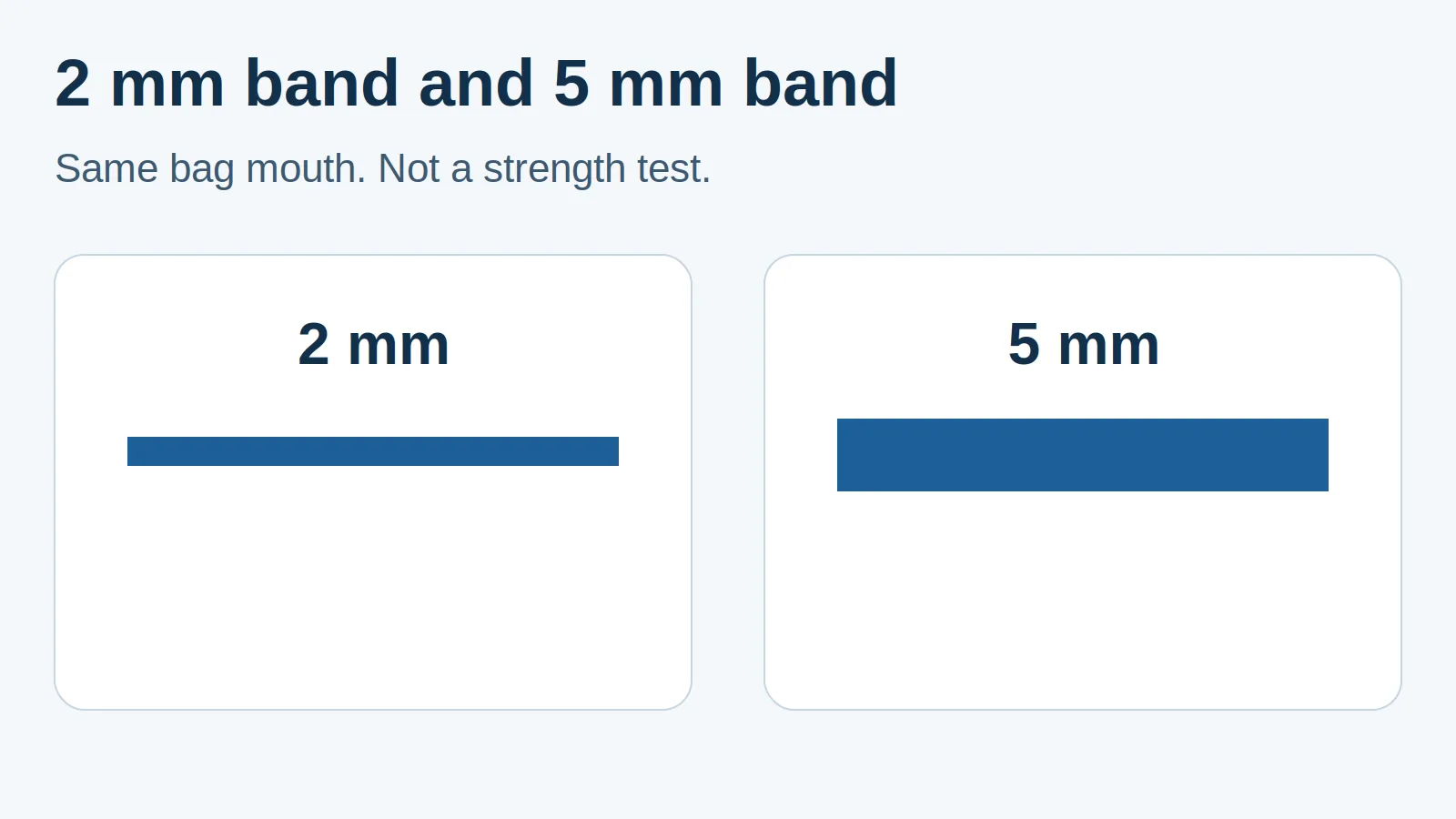
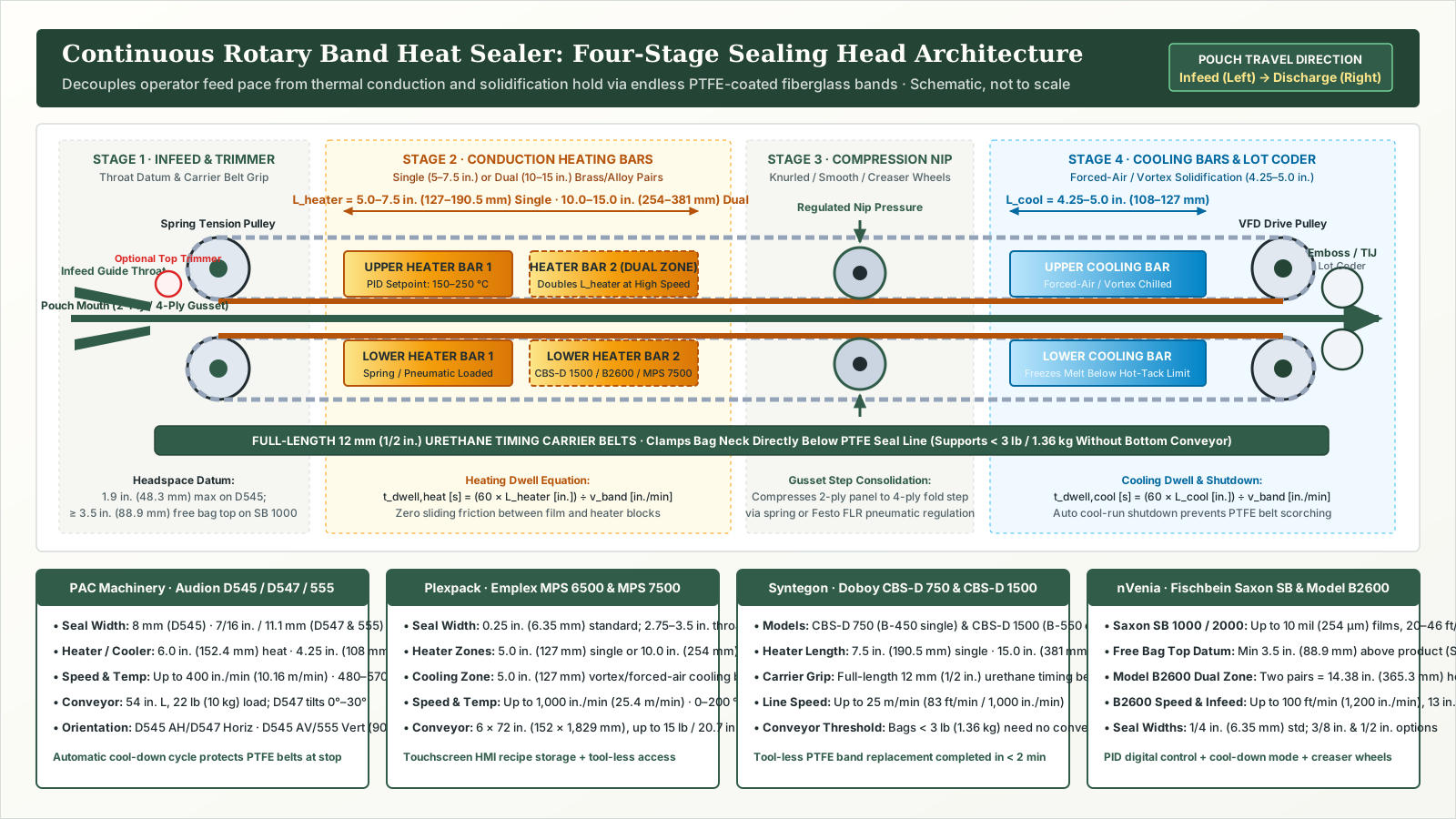
On an intermittent bench impulse sealer, the operator places one bag mouth between stationary jaws, triggers a timed electrical pulse through a 2 mm or 5 mm nichrome wire, and holds the jaws closed until the molten polyethylene solidifies (compare impulse heat sealer wire widths and timer settings). During both the heating phase and the closed-jaw congealing phase, the operator’s hands remain tied to that single pouch. A band sealer machine—also referred to in plant documentation as a continuous band sealer or rotary band heat sealer—eliminates stationary jaw wait time by moving the pouch mouth continuously through four dedicated mechanical zones:
- Infeed Guide, Carrier Belt Grip, and Optional Scrap Trimmer (
Stage 1): The operator feeds the flattened top edge of the pouch into the infeed guide slot (throat). Immediately below the sealing line, counter-rotating urethane timing/carrier belts (full-length 12 mm / 1/2 in. profile belts on Syntegon Doboy CBS-D 750 and CBS-D 1500or a13 in. / 330 mm driven infeed section on the nVenia Fischbein Model B2600) clamp the neck of the bag so the pouch cannot skew, sag, or pull out of alignment. Where excess bag header must be removed for retail presentation or clean lot coding, an integrated rotary bag top trimmer blade shaves the top strip ahead of the heater entry. - Endless PTFE-Coated Fiberglass Sealing Bands & Heated Bar Pairs (
Stage 2): Two endless, counter-rotating PTFE (Teflon®) coated fiberglass bands sandwich the pouch mouth and carry it between stationary, spring-loaded or pneumatically regulated brass, copper, or hardened-alloy heating bars. Because the PTFE bands travel at the exact linear velocity of the pouch (v_band), there is zero sliding friction between the softening polymer film and the stationary heater blocks; the sliding interface occurs strictly between the back face of the PTFE fiberglass belt and the polished heater bar face. - Inter-Zone Compression / Sealing Rollers (
Stage 3): Exiting or straddling the heating bar pairs, spring-loaded or pneumatically loaded compression wheels (knurled, smooth flat, or creaser rollers) apply concentrated line pressure through the PTFE bands. This nip force expels trapped air and presses molten sealant into multi-layer thickness steps, such as the transition from a2-plyflat face to a4-plyside gusset fold or back center fin seam. - Forced-Air or Vortex Cooling Bars & Exit Lot Coder (
Stage 4): While still clamped between the moving PTFE bands, the pouch travels between forced-air cooling bars (4.25 in. / 108 mm on PAC Machinery Audion D545, D547 AHS, and 555;5.0 in. / 127 mm on Plexpack Emplex MPS 6500 and MPS 7500) or an external vortex-chilled cooling module (available on the nVenia Fischbein Saxon SB 2000). Cooling the joint under continuous band pressure brings the polymer below its crystallization temperature before release, preventing hot-tack peel. At the exit nip, a rotary embossing coder wheel, hot-stamp coder, or thermal-inkjet (TIJ) head imprints the batch or expiration code directly above or across the cooled seal.
Representative OEM Benchmark Comparison Across Tabletop and Industrial Band Sealers
Published specifications from four primary packaging machinery manufacturers illustrate how heating bar length, cooling bar length, throat geometry, and conveyor capacity scale from compact benchtop units to high-speed dual-heater industrial lines:
| Manufacturer & Model Series | Machine Class & Orientation | Documented Seal Width & Throat Datum | Heating & Cooling Bar Zone Lengths | Speed Range, Film Gauge & Conveyor Capacity |
|---|---|---|---|---|
PAC Machinery / Audion Elektro D545 AH & D545 AV |
Tabletop rotary band heat sealer (67 lb / 30.4 kg horizontal D545 AH; 100 lb / 45.4 kg vertical D545 AV) |
8 mm (5/16 in.) seal width; 1.9 in. (48.3 mm) max distance from top of bag to seal centerline |
Compact tabletop heater pair + 4.25 in. (108.0 mm) cooling bar; max setpoint 480 °F (250 °C) |
Up to 400 in./min (10 m/min / 33.3 ft/min); 4.4 × 26.4 in. (112 × 671 mm) conveyor (AH slides out 2.75 in. / 70 mm; AV handles 4.5–16.5 in. tall upright bags) |
PAC Machinery / Audion D547 AHS & Audion 555 |
Heavy-duty floor-standing stainless conveyor sealers (D547 AHS horizontal with 0°–30° conveyor tilt; 555 vertical / 90° convertible to horizontal) |
7/16 in. (11.1 mm) wide seal; optional 4.0 in. (101.6 mm) extended header throat clearance (Audion 555) |
6.0 in. (152.4 mm) heater bar pair + 4.25 in. (108.0 mm) cooling bar; 480 °F (249 °C) standard (up to 570 °F / 299 °C high-heat coffee bag option on 555) |
Up to 400 in./min (10.16 m/min / 33.3 ft/min); 54 in. (1,372 mm) conveyor with 22 lb (10 kg) load rating; motorized head height & 9 digital recipes (D547 AHS); auto cool-down cycle |
Plexpack / Emplex MPS 6500 & MPS 7500 (plus MPS 6100 / 7100) |
Modular stainless industrial continuous band sealers on lockable caster stands with touchscreen PLC/HMI | 0.25 in. (6.35 mm / 1/4 in.) standard seal width; 2.75–3.5 in. (70–89 mm) seal throat depth |
5.0 in. (127 mm) single heater bar (MPS 6500) or 10.0 in. (254 mm) dual heater zones (MPS 7500) + 5.0 in. (127 mm) cooling bar (0–200 °C / 32–392 °F) |
Up to 1,000 in./min (25.4 m/min / 83.3 ft/min); 6 × 72 in. (152 × 1,829 mm) conveyor supporting 15 lb (6.8 kg) standard bag weight and up to 20.7 in. (526 mm) product height |
Syntegon / Doboy CBS-D 750 (B-450) & CBS-D 1500 (B-550) |
Industrial continuous bag & medical pouch sealers (horizontal, vertical, or stand-alone carrier-belt head) |
Standard industrial band widths + full-length 12 mm (1/2 in.) urethane timing carrier belts below PTFE band |
7.5 in. (190.5 mm) single heating bar pair (CBS-D 750 / B-450) or 15.0 in. (381.0 mm) dual heating bar pairs (CBS-D 1500 / B-550) + air cooling bars |
Up to 25 m/min (83 ft/min / 1,000 in./min); bags < 3 lb (1.36 kg) require no support conveyor; Festo FLR digital pneumatic roller pressure; < 2 min tool-less PTFE band change |
nVenia / Fischbein Saxon SB 1000 / SB 2000 & Model B2600 |
Heavy-duty upright bag & gusseted pouch sealers (PE, PP, polylaminates, and co-extrusions up to 10 mil / 254 µm) |
1/4 in. (6.35 mm) standard (3/8 in. / 9.5 mm & 1/2 in. / 12.7 mm on B2600); requires ≥ 3.5 in. (88.9 mm) free bag top above product (SB 1000/2000) |
SB 1000/2000: high-efficiency PID heat module + vortex cooler (SB 2000); B2600: two pairs = 14.38 in. (365.3 mm) heating bars + forced-air cooling |
Saxon SB 1000/2000: 20–46 ft/min (240–552 in./min / 6.1–14.0 m/min); Model B2600: up to 100 ft/min (1,200 in./min / 30.5 m/min) with 13 in. (330 mm) driven infeed & 32.5–56.5 in. pedestal height |
Choose horizontal, tilted, or vertical orientation from the filled pouch state
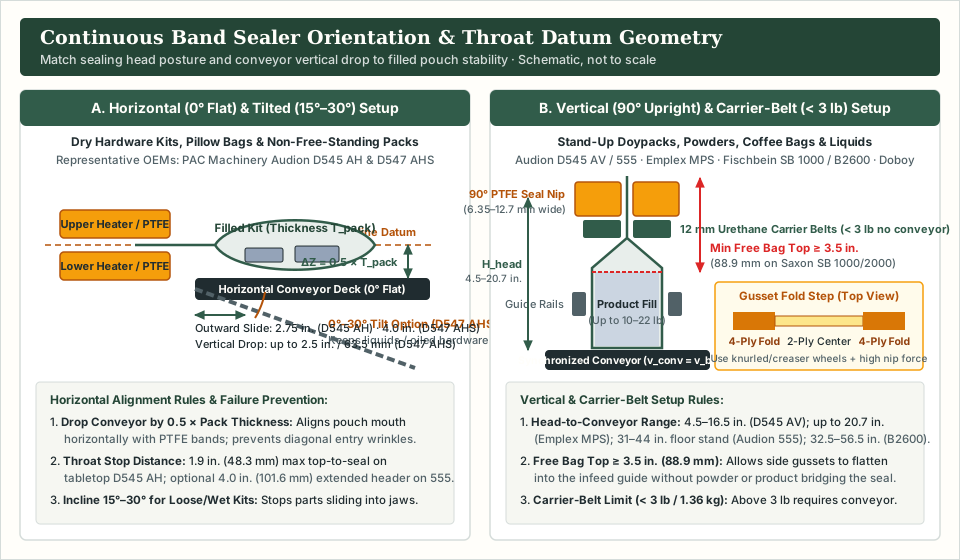
When comparing continuous band sealer horizontal vs vertical configurations for a workstation in the kitting equipment or packaging area, the orientation label describes the posture of the filled pouch as it passes through the PTFE sealing bands, not the shape of the floor stand. Choosing the wrong orientation forces the operator to fight gravity at the infeed throat, driving part migration into the seal area or diagonal neck wrinkles.
1. Horizontal Configuration (0° Flat Conveyor Deck)
In a horizontal band sealer—such as the tabletop PAC Machinery Audion D545 AH or the floor-standing Audion D547 AHS—the PTFE sealing bands lie in a horizontal plane parallel to the conveyor belt, and the pouch travels lying flat on its side.
- Target kits and pouches: Pre-assembled dry hardware kits, fastener assortments, injection-molded plastic components, medical device trays, and flat 2-ply pillow pouches loaded upstream at a manual bench or small-parts bagging workstation (when the station seals pre-filled loose pouches rather than opening and sealing bags on a roll via a tabletop bagging machine).
- Vertical conveyor drop and outward slide datum (
ΔZ = 0.5 × T_pack): When a flat poly bag is filled with bulky hardware to a total pack thicknessT_pack(for example, 50 mm / 2.0 in.), the natural centerline of the bag mouth sits0.5 × T_pack(25 mm / 1.0 in.) above the conveyor belt surface. If the conveyor deck remains flush with the PTFE sealing nip (ΔZ = 0), the bag mouth must bend sharply downward to enter the throat, pulling the top film ply shorter than the bottom ply and locking a diagonal wrinkle across the8 mmor11.1 mmseal band. - OEM adjustment range: To center thick packages on the horizontal seal nip, the Audion D547 AHS lowers its
10 × 54 in.(254 × 1,372 mm) conveyor vertically by up to2.5 in.(63.5 mm)—accommodating pack thicknesses up to5.0 in.(127 mm)—and slides the conveyor outward horizontally by4.0 in.(101.6 mm) away from the sealing head. On the compact tabletop Audion D545 AH, the4.4 × 26.4 in.(112 × 671 mm) conveyor pulls out2.75 in.(70 mm) toward the operator to support wide or bulky flat bags while keeping the top edge against the1.9 in.(48.3 mm) throat stop.
2. Inclined / Tilted Horizontal Configuration (15° to 30° Declined Conveyor)
Some small-batch packs contain loose small fasteners, oiled bearings, or semi-liquid components inside thin, non-gusseted flat bags. If laid flat at 0°, loose parts roll forward into the heater throat or oil migrates across the inner polyethylene sealant layer; if stood upright at 90°, the thin flat bag collapses on the narrow vertical conveyor.
- OEM adjustment range: The Audion D547 AHS integrates a tilting conveyor deck that angles downward from
0° to 30°. Gravity holds the loose or wet contents settled against the bottom seam while the full face of the pouch rests supported on the inclined belt.
3. Vertical Configuration (90° Upright Sealing Head Over Synchronized Conveyor)
In a vertical continuous band sealer—such as the tabletop Audion D545 AV, the convertible Audion 555, the Plexpack Emplex MPS 6500 / 7500, or the nVenia Fischbein Saxon SB 1000 / SB 2000 and Model B2600—the sealing head is rotated 90° so the PTFE bands clamp the upright top fin while the pouch base stands on the bottom conveyor between lateral guide rails.
- Target kits and pouches: Stand-up pouches (
Doypacks), block-bottom and side-gusseted coffee bags (including bags with one-way degassing valves), powdered reagents, granular hardware bulk packs, and liquid pouches that would spill if tipped onto their side. - Head-to-conveyor standing height datum (
H_head = H_bag - d_top): The vertical distance from the conveyor belt surface to the PTFE band centerline must match the standing height of the filled pouch (H_bag) minus the top seal offset (d_top). Across representative platforms, vertical pouch height adjustment spans:- Tabletop
Audion D545 AV: Seals upright bags from4.5 to 16.5 in.(114 to 419 mm) tall. - Industrial
Plexpack Emplex MPS 6500 / 7500: Accommodates upright product heights up to20.7 in.(526 mm) with a floor-to-sealer height adjustment of27.5 to 40.5 in.(699 to 1,029 mm). - Convertible
Audion 555: Crank-adjustable sealing head height from31 to 44 in.(787 to 1,118 mm) in the vertical position (and 26 to 39 in. / 660 to 991 mm when rotated 90° to horizontal), paired with a22 lb(10 kg) conveyor and an optional4.0 in.(101.6 mm) extended header throat for pouches with hang holes or zipper headers. - Pedestal
Fischbein Model B2600: Adjustable pedestal height from32.5 to 56.5 in.(826 to 1,435 mm) above the floor for tall pillow and gusseted sacks.
- Tabletop
- Minimum free bag top headspace rule (
≥ 3.5 in. / 88.9 mm): On upright gusseted bags, nVenia Fischbein’s Saxon SB 1000 and SB 2000 specifications mandate a minimum3.5 in.(8.89 cm/88.9 mm) of unfilled free bag top above the product line. When an upright bag is overfilled (leaving less than 3.5 in. of top clearance), the product bulk pushes outward against the side gussets right below the urethane carrier belts, preventing the4-plygusset folds from flattening into the infeed guide and causing channel leaks or product crushing in the heater bars.
4. Stand-Alone Carrier-Belt-Only Configuration (No Bottom Conveyor, < 3 lb / 1.36 kg)
For lightweight flat pouches where bench space is constrained or where the sealing head is mounted over an existing plant conveyor, Syntegon’s Doboy CBS-D 750 (B-450) and CBS-D 1500 (B-550) documentation establishes an explicit mass threshold: bags weighing under 3 lb (1.36 kg) do not require a support conveyor. Full-length 12 mm (1/2 in.) urethane timing belts positioned directly below the PTFE sealing bands clamp the bag neck and carry the suspended weight through the heating, compression, and cooling zones.
Decision rule on orientation and support:
- If filled pouch contents are dry, non-spillable solids and pack thickness
T_pack ≤ 125 mm(5.0 in.) → prioritize a horizontal (0°) conveyor setup with the conveyor bed dropped byΔZ = 0.5 × T_packbelow the PTFE band centerline. - If contents are loose granules, oiled hardware, or liquids in non-standing bags → prioritize an inclined (
15°–30°) horizontal conveyor (such as the Audion D547 AHS) so gravity retains contents at the bottom seam while the belt supports the bag face. - If pouches are stand-up Doypacks, side-gusseted bags, powders, or liquids, OR if bag mass exceeds
3 lb(1.36 kg) in upright transport → prioritize a vertical (90°) sealing head with a speed-synchronized bottom conveyor and enforce≥ 3.5 in.(88.9 mm) of free bag top above the product fill level.
| Orientation & Support Mode | Target Pouch & Content State | Mechanical Datum & Clearance Rule | Dominant Failure Mode & Prevention |
|---|---|---|---|
Horizontal (0° Flat Conveyor)Audion D545 AH, D547 AHS |
Dry hardware kits, fasteners, medical trays, flat 2-ply pillow bags | Lower conveyor deck by ΔZ = 0.5 × T_pack (up to 2.5 in. / 63.5 mm drop on D547 AHS); slide conveyor outward 2.75–4.0 in. for wide packs |
Diagonal mouth wrinkling: A conveyor set too high or too low bends the bag neck at entry; align bag centerline with the PTFE nip before feeding. |
Inclined Horizontal (15°–30° Tilt)Audion D547 AHS ( 0°–30° tilt) |
Oiled hardware, loose small parts, semi-liquids in floppy non-standing bags | Tilt conveyor 15°–30° downward away from the sealing head while maintaining 1.9–3.5 in. top throat clearance |
Part or oil migration into seal: Insufficient tilt allows contents to slide into the heater nip; increase tilt angle and verify clean inner sealant plies. |
Vertical (90° Upright + Conveyor)Audion D545 AV, 555, Emplex MPS, Fischbein SB / B2600 |
Stand-up Doypacks, coffee bags, powders, liquids, heavy gusseted sacks (up to 15–22+ lb) |
Set head height H_head = H_bag - d_top (4.5–20.7 in.); preserve ≥ 3.5 in. (88.9 mm) free bag top above fill (Saxon SB 1000/2000) |
** Seal shear or gusset bridging:** Mismatched conveyor-to-band speed tips the upright bag and tears the hot seal; overfilling (< 3.5 in. headspace) pops open gusset folds. |
Carrier-Belt-Only (No Conveyor)Syntegon Doboy CBS-D 750 / 1500 |
Lightweight flat or header pouches weighing < 3 lb (1.36 kg) |
Feed bag neck straight so the full width of the 12 mm (1/2 in.) urethane timing belts grips below the PTFE band |
Hot-tack neck elongation: Running pouches ≥ 3 lb (1.36 kg) without bottom conveyor support stretches or pulls the molten seal out of the PTFE bands. |
Calculate heating and cooling dwell time from bar length and band speed
On a stationary impulse sealer, heating time and congealing time are controlled directly by the timer circuit while the bag sits motionless (see the impulse sealer cycle formula). On a rotary band heat sealer, the heater bars (L_heater) and cooling bars (L_cool) have fixed physical lengths along the machine axis. Consequently, conductive heating dwell time (t_dwell,heat) and cooling dwell time (t_dwell,cool) are inversely proportional to linear band speed (v_band):
Heating & Cooling Dwell Time Equations (Continuous Rotary Band Heat Sealer):

  t_dwell,heat [s] = L_heater / v_band
                   = (60 × L_heater [in.]) ÷ v_band [in./min]
                   = (60 × L_heater [mm])  ÷ (1,000 × v_band [m/min])

  t_dwell,cool [s] = L_cool / v_band
                   = (60 × L_cool [in.]) ÷ v_band [in./min]
                   = (60 × L_cool [mm])  ÷ (1,000 × v_band [m/min])

  Maximum Pouch Feed Rate at Operator Pace or Conveyor Pitch:
  N_pouch_max [pouches/min] = v_band [in./min] ÷ (W_pouch [in.] + G_gap [in.])
where:
L_heaterandL_coolare the active contact lengths of the heated bar section and cooled bar section (in.ormm),v_bandis the linear surface speed of the PTFE sealing bands (in./minorm/min, where1 m/min = 39.37 in./min = 3.28 ft/min),W_pouchis the pouch mouth width along the travel direction (in.), andG_gapis the spacing between consecutive pouches (in.).
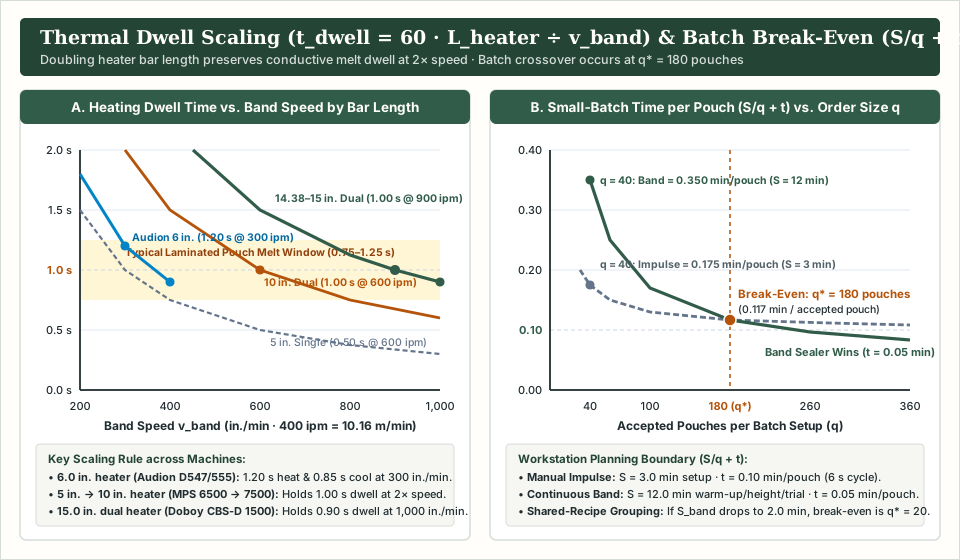
Why High-Speed Laminated Pouches Require Dual Heating Zones (10 to 15 in.) Instead of Higher Temperatures
Multi-layer barrier laminates (such as 4 to 8 mil PET / aluminum foil / LLDPE stand-up pouches or 6 to 10 mil gusseted polyethylene bags rated on the Fischbein Saxon SB 1000/2000) require 0.75 to 1.25 seconds of conductive heat dwell for thermal energy to conduct from the brass heater blocks, through the PTFE-coated fiberglass belt, and through the outer carrier plies to melt the inner sealant interface (typically 110–135 °C at the inner LLDPE or mLLDPE layer).
If an operator increases band speed without lengthening the heater bars, t_dwell,heat drops proportionally. Attempting to compensate for a short 0.35–0.45 s dwell by turning the heater PID controller above 240–260 °C (464–500 °F) creates an excessive thermal gradient across the film thickness: the outer PET or polypropylene layer delaminates, shrinks, or chars against the PTFE band before heat reaches the center of a 4-ply gusset fold. Comparing three documented OEM heating architectures demonstrates how bar length governs usable line speed:
- Worked Case 1 — Single
6.0 in.(152.4 mm) Heater &4.25 in.(108.0 mm) Cooler (PAC Machinery Audion D547 AHS & Audion 555): Running a laminated stand-up pouch at an intermediate speed ofv_band = 300 in./min(25.0 ft/min/7.62 m/min=5.0 in./s):- Heating dwell:
t_dwell,heat = (60 × 6.0 in.) ÷ 300 in./min = 1.20 s - Cooling dwell:
t_dwell,cool = (60 × 4.25 in.) ÷ 300 in./min = 0.85 sAt the machine’s maximum speed ofv_band = 400 in./min(33.3 ft/min/10.16 m/min), heating dwell decreases to(60 × 6.0) ÷ 400 = 0.90 sand cooling dwell to(60 × 4.25) ÷ 400 = 0.64 s—remaining inside the0.75–1.25 sconduction window for standard pouches.
- Heating dwell:
- Worked Case 2 — Single
5.0 in.(127 mm) vs. Dual10.0 in.(254 mm) Heater (Plexpack Emplex MPS 6500vs.MPS 7500): Atv_band = 300 in./min(7.62 m/min), a single5.0 in.heating zone on theMPS 6500providest_dwell,heat = (60 × 5.0) ÷ 300 = 1.00 s(and 1.00 s cooling across its 5.0 in. cooling bar). If a plant doubles conveyor speed tov_band = 600 in./min(50.0 ft/min/15.24 m/min), a single5.0 in.heater cuts dwell time in half to0.50 s, whereas the dual-zone10.0 in.(254 mm) heater on theMPS 7500delivers(60 × 10.0) ÷ 600 = 1.00 s, preserving the exact same thermal penetration at twice the throughput. - Worked Case 3 — Dual-Pair
14.38 in.(365.3 mm) &15.0 in.(381.0 mm) Industrial Heaters (nVenia Fischbein B2600&Syntegon Doboy CBS-D 1500): At a high-speed production rate ofv_band = 900 in./min(75.0 ft/min/22.86 m/min), the two7.5 in.heating bar pairs (15.0 in.total) on the Syntegon Doboy CBS-D 1500 (B-550) delivert_dwell,heat = (60 × 15.0) ÷ 900 = 1.00 s(and 0.90 s at its 1,000 in./min / 25 m/min ceiling). Similarly, the two heat bar pairs (14.38 in.total) on the Fischbein Model B2600 deliver(60 × 14.38) ÷ 600 = 1.44 sat50 ft/min(600 in./min) for heavy gusseted sacks and0.72 sat its100 ft/min(1,200 in./min/30.5 m/min) maximum speed for thinner polyethylene pillow bags.
Applying the S/q + t Small-Batch Cost Boundary (When Does a Band Sealer Beat a Bench Impulse Sealer?)
In small-batch packaging, a machine’s catalog speed in inches per minute never equals workstation output. As defined in the kitting cost model, an assistive machine reduces labor time per order only when it lowers total paid minutes per accepted kit across the entire job boundary:
Small-Batch Paid Time per Accepted Pouch:

  Paid minutes per accepted pouch = (S ÷ q) + t

  Break-Even Batch Quantity (q*) Between Impulse (1) and Continuous Band (2):
  q* = (S_band - S_impulse) ÷ (t_impulse - t_band)
where S is paid setup, thermal warm-up, height/guide adjustment, first-piece trial, and job clearance minutes; q is accepted pouches in the batch; and t is paid running minutes per accepted pouch.
Consider a workstation sealing pre-filled 6 in. (152 mm) wide hardware pouches under two operating methods (workstation planning scenario):
- Manual Bench Impulse Sealer (
Method 1): Because an impulse element heats only when triggered, thermal warm-up is zero. Clearing the previous job, verifying the timer dial, and testing one sample bag takesS_impulse = 3.0 min. During the run, picking up the filled pouch, flattening the mouth, waiting1.5 sfor heating +1.5 sfor closed-jaw congealing, and placing the sealed pack into the tote requires6.0 sper pouch, ort_impulse = 0.10 min/pouch(10 pouches/min). - Continuous Rotary Band Heat Sealer (
Method 2 — Full Changeover): Bringing the brass heater blocks to thermal equilibrium (while staging bins), setting head-to-conveyor height (H_headorΔZ), aligning the embossing lot coder characters, running2 to 3sacrificial verification pouches, and clearing the lot requiresS_band = 12.0 min(automatic cool-down shutdown on the Audion D545/D547/555 and Fischbein Saxon SB 1000 runs unattended at shift end). Once running, the operator simply feeds each pouch top into the urethane carrier belts every3.0 swhile the previous pouch travels through the heating and cooling bars automatically, cutting active running time tot_band = 0.05 min/pouch(20 pouches/min).
Solving for the break-even batch quantity q* on an isolated changeover:
q* = (12.0 min - 3.0 min) ÷ (0.10 min/pouch - 0.05 min/pouch) = 9.0 ÷ 0.05 = 180 accepted pouches- Micro-batch (
q = 40 pouches): The manual impulse sealer requires(3.0 ÷ 40) + 0.10 = 0.175 min/pouch(7.0 mintotal paid job time), whereas a cold changeover on the continuous band sealer requires(12.0 ÷ 40) + 0.05 = 0.350 min/pouch(14.0 mintotal). - Medium batch (
q = 360 pouches): The manual impulse sealer requires(3.0 ÷ 360) + 0.10 = 0.108 min/pouch(39.0 mintotal), whereas the continuous band sealer drops to(12.0 ÷ 360) + 0.05 = 0.083 min/pouch(30.0 mintotal, recovering9.0 minof operator capacity). - Grouped SKU scheduling (
Shared Recipe & Pouch Height, S_band = 2.0 min): When the warehouse kitting schedule groups consecutive small orders that use the exact same pouch laminate and standing height (or recalls one of the 9 digital recipes on the Audion D547 AHS / PLC recipes on the Emplex MPS 7500 while the heater blocks remain hot),S_banddrops to2.0 min—making the continuous band sealer faster than the impulse sealer across every batch size (even at q = 20 pouches).
Check PTFE band tracking, gusset transitions, and cool-down shutdown
Even when heater temperature and band speed (v_band) are matched to the film gauge, three mechanical setup faults cause seal rejects or premature component wear on a band sealer machine. Build these three physical checks into the workstation’s kitting quality control routine before releasing production kits:
1. Eliminating 2-Ply to 4-Ply Gusset and Fin-Seam Channel Leaks
Side-gusseted coffee pouches (sealed on the Audion 555 or Fischbein Saxon SB 1000/2000) and back-seam pillow bags present four layers (4-ply) of film along the gusset tucks or vertical fin seam, stepping down abruptly to two layers (2-ply) across the center panel.
- Physical failure mechanism: Rigid heating bars and under-pressurized compression rollers ride up on the thicker
4-plyridges. That step elevation leaves a microscopic unpressurized triangular gap (0.05 to 0.15 mmwide) right beside the gusset fold where the two inner sealant layers touch without coalescing. In addition, conductive cooling time scales with the square of total wall thickness (t_cool ∝ d_wall²), meaning the4-plyfold retains heat four times longer than the2-plycenter web and peels open under hot-tack tension if cooling bar dwell is too short. - Corrective setup:
- Increase compression wheel pressure (
regulated via the Festo FLR digital pneumatic filter-regulator on the Syntegon Doboy CBS-D series or the mechanical jaw/roller pressure adjusters on the PAC Machinery Audion 555 and D547 AHS). - Equip the compression station with textured knurled pressure rollers or dedicated creaser wheels (
available on the Fischbein Model B2600) to deform and lock the2-plyto4-plystep transition. - Maintain cooling dwell
t_dwell,cool ≥ 0.70 to 1.00 s(for example, running ≤ 360 in./min on a 4.25 in. Audion cooling bar or adding the external vortex cooler on the Fischbein Saxon SB 2000) so the4-plygusset core solidifies completely before exiting the PTFE bands.
- Increase compression wheel pressure (
2. Inspecting PTFE-Coated Fiberglass Band Tracking and Carrier Belt Wear
The two endless PTFE-coated fiberglass bands run under spring tension between the driven exit pulleys and idler entry pulleys.
- Physical failure mechanism: If adhesive residue, melted polyethylene exudate, or powder builds up unevenly on a pulley crown—or if pulley shafts drift out of parallel—the PTFE band walks upward or downward against the pulley flange. Once the fiberglass edge frays, the band folds over or exposes the bare brass heater block, sticking immediately to the next pouch.
- Corrective setup: Observe belt tracking for
30 secondsduring warm-up before feeding bags. Wipe polymer residue from pulley crowns and PTFE surfaces using a non-abrasive cloth, and keep a spare pair of PTFE bands and12 mmurethane carrier belts at the station (tool-less PTFE band replacement takes under 2 minutes on the Syntegon Doboy CBS-D 750/1500 and uses quick-release belt tensioners on the Fischbein Saxon SB 1000/2000 and Plexpack Emplex MPS series).
3. Enforcing the Automatic Cool-Down Shutdown Cycle
The single most common cause of ruined PTFE sealing belts in small-batch operations is turning off the main power disconnect at the end of a job while the heater blocks are still at 180 to 250 °C (356 to 482 °F).
- Physical failure mechanism: When the drive motor stops while the brass or copper heater bars remain hot, the
5 to 15 in.segment of the PTFE-coated fiberglass band clamped stationary between the jaws bakes at full conduction temperature. This chars the PTFE fluoropolymer coating, embrittles the fiberglass weave, and permanently sets a flat crease in the urethane carrier belt. - Corrective setup: Always stop the machine using its automatic cool-down / cool-run mode (
standard on the PAC Machinery Audion D545 AH/AV, D547 AHS, and 555, as well as the nVenia Fischbein Saxon SB 1000/2000 and Model B2600). In cool-down mode, the PID controller cuts electrical power to the heating cartridges while keeping the band drive motor and cooling blower running until heater block temperature drops safely below80 to 100 °C(176 to 212 °F), after which the drive shuts off automatically.
Copyable Continuous Band Sealer Setup & First-Piece Qualification Record
Record these five verification gates on the order traveler whenever changing pouch SKU, film structure, or shift setup:
| Setup & Qualification Field | Workstation Parameters to Record | Acceptance Gate & Threshold Stop Rule |
|---|---|---|
| 1. Pouch Structure, Ply Count & Free Bag Top | Film laminate structure & gauge (mil / µm, up to 10 mil / 254 µm on Saxon SB 1000), 2-ply flat vs. 4-ply gusset/fin zones, filled bag weight (lb / kg), and measured free bag top above fill (in. / mm) |
Gate: Upright gusseted bags preserve ≥ 3.5 in. (88.9 mm) free bag top (Saxon SB 1000/2000); flat bags fit within the 1.9–4.0 in. throat stop. Bags ≥ 3 lb (1.36 kg) run on a synchronized bottom conveyor. |
| 2. Orientation, Head Height & Conveyor Drop | Orientation (0° horizontal, 15°–30° tilted, or 90° vertical), head-to-conveyor height H_head or vertical drop ΔZ = 0.5 × T_pack (mm / in.), horizontal slide-out (mm), and digital recipe number (e.g., Recipe 1–9 on D547 AHS) |
Gate: Filled pouch mouth enters the PTFE bands parallel to the nip without upward pull, downward neck bend, or forward/backward tipping on the conveyor. |
3. Heater Temp, Band Speed & Dwell (t_dwell) |
Heater PID setpoint (°C / °F per zone), linear band speed v_band (in./min or m/min), heater bar length L_heater (in. / mm), cooling bar length L_cool (in. / mm), and calculated t_dwell,heat and t_dwell,cool (s) |
Gate: Never copy a speed dial (in./min) across sealers with different heater lengths (5 in. vs. 6 in. vs. 15 in.); match calculated thermal dwell (s) and verify conveyor speed synchronization (v_conveyor = v_band). |
| 4. Compression Wheel Pressure, Gusset & Coder Check | Roller profile (knurled, smooth, creaser), spring or pneumatic pressure (psi / bar on Festo FLR or turn mark), emboss/TIJ lot code string, and cooled peel inspection across 2-ply to 4-ply transitions |
Stop Rule: If even one trial pouch exhibits an open channel at a gusset fold, hot-tack separation at discharge, or an illegible lot code, stop and adjust roller pressure, cooling dwell, or coder alignment before releasing the batch. |
| 5. PTFE Band Tracking & Cool-Down Shutdown Log | PTFE fiberglass band surface and edge alignment, 12 mm urethane carrier belt grip condition, top trimmer scrap bin clearance, and confirmation of automatic cool-down cycle at run completion |
Gate: Zero PTFE edge fraying or resin build-up on pulleys; machine shut down strictly via automatic cool-down mode (never hard-switched off while heater bars exceed 100 °C). |
Technical basis and scope
Equipment capabilities, zone dimensions, speed envelopes, and mechanical thresholds in this guide are grounded in primary technical documentation from PAC Machinery / Audion Elektro (Audion 555 Vertical/Convertible Band Sealer, Audion D547 AHS Horizontal Band Sealer, and Audion D545 AH / D545 AV Tabletop Rotary Band Sealers), Syntegon Technology GmbH (Doboy CBS-D 750 / B-450 and CBS-D 1500 / B-550 Continuous Bag Sealers), nVenia / Duravant Fischbein Brand (Saxon SB 1000 & SB 2000 Band Sealers and Model B2600 High-Speed Dual-Heater Band Sealer), and Plexpack Corp. / Emplex (MPS 6500 & MPS 7500 Continuous Band Bag Sealers).
Conductive heating and cooling dwell equations (t_dwell = 60 × L ÷ v_band), conveyor vertical drop geometry (ΔZ = 0.5 × T_pack), and the small-batch S/q + t break-even comparison apply physical heat-transfer and workstation time-study principles to small-batch kitting and pouch-sealing operations. Qualify final temperature, belt speed, and nip pressure settings on production pouch samples using the small-batch packaging and kitting quality control verification records. Updated October 2026.