A faster sealing cycle can leave the job cost unchanged if operators still spend the shift selecting parts and clearing orders. Compare manual and assisted work using the same order mix and accepted-kit denominator.
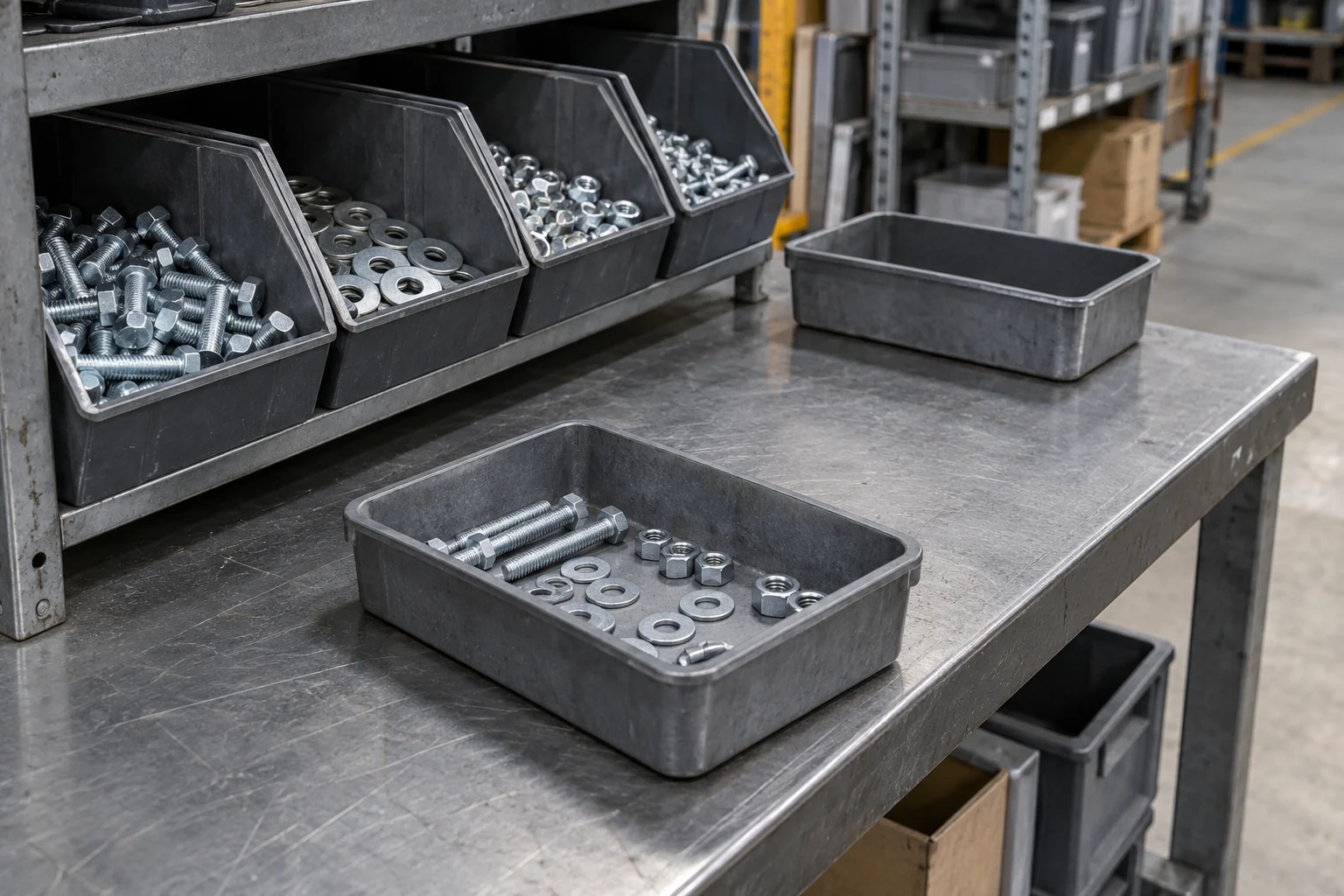
An assist earns its place when the value of reduced work or usable capacity exceeds its added ownership and operating cost. Separate labor hours recovered from cash that the business will actually stop spending. For short runs, setup and clearance can outweigh the saving during each packing cycle.
Define the cost boundary around a job
Include release, setup, replenishment, assembly, checking, packing, rework and clearance. Keep material purchase cost in both alternatives unless the proposal changes it. If both methods use identical components, the comparison can show those unchanged costs separately so the equipment effect remains visible.
Interlake Mecalux’s kitting guide distinguishes kit preparation from downstream assembly and describes stock coordination. That provides a useful boundary for observing the work. It does not provide a cost rate for your operation.
Use paid labor hours, not elapsed wall-clock time multiplied by an assumed headcount. If people overlap briefly, capture their actual contribution. If an operator shares a bagger between jobs, allocate its costs once under a stated rule.
Build the comparison with these equations
Let H be paid hours charged to the jobs, R the fully burdened hourly labor rate, V the variable packaging and operating cost, F the equipment and fixed costs allocated to the period, and G accepted kits in that period.
Cost per accepted kit = (H × R + V + F) / G. Use one currency and one accounting period throughout. Do not calculate this figure when G is zero; record the failed or unfinished period and its cost separately.
| Input | Manual observation | Assisted observation |
|---|---|---|
| Order mix and quantities | Record actual jobs | Use the same mix or explain differences |
| Setup and clearance hours | Fill from time record | Include recipe, tooling and film changes |
| Running and replenishment hours | Include all assigned staff | Include upstream assistance |
| Rework hours | Record separately | Include failures discovered after packing |
| Variable cost | Bags, labels and consumables | Add changed consumables and utilities |
| Fixed cost allocation | Existing tools or workstation | Installed equipment, service and financing basis |
| Accepted kits | Released quantity only | Apply the same acceptance rules |
Blank job-cost worksheet
Copy this table into your records, print it, or download the blank CSV worksheet. Enter both methods for one period and currency. Add the paid hours for every person assigned to the jobs; use zero for a measured cost or time that did not occur. Leave an unknown value blank until you have evidence for it.
| Record or calculation | Manual value | Assisted value |
|---|---|---|
| Period: start and end | __________ | __________ |
| Currency | __________ | __________ |
| Order mix, quantities and acceptance rule | __________ | __________ |
| Setup and clearance: paid hours | __________ | __________ |
| Running, replenishment and other job work: paid hours | __________ | __________ |
| Rework: paid hours | __________ | __________ |
| H: total of the three paid-hours rows above | __________ | __________ |
| R: fully burdened labor rate, currency/hour | __________ | __________ |
| V: variable packaging and operating cost, currency | __________ | __________ |
| F: allocated equipment and fixed cost, currency | __________ | __________ |
| G: accepted kits, count | __________ | __________ |
| Total job cost: H × R + V + F, currency | __________ | __________ |
| Cost per accepted kit: total job cost / G, currency/kit | __________ | __________ |
| Source records and allocation notes | __________ | __________ |
Calculate the last two cost rows after filling all inputs. The CSV contains the same blank record for manual entry and calculation; it has no automatic formulas. If G is zero, leave cost per accepted kit blank and retain the total cost with an explanation. If hourly rates differ between people, use a paid-hours-weighted R so H × R equals their combined labor cost.
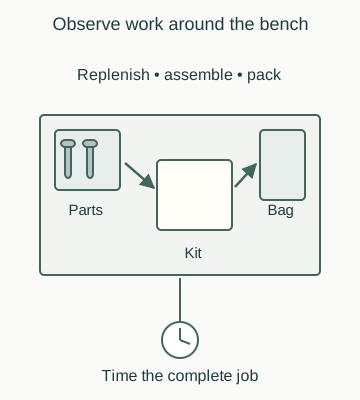
The diagram maps the three workstation stages—replenishment, kit assembly, and bagging—to time as a single job boundary. Use the kitting process map to keep the observations consistent.
Test sensitivity to batch size
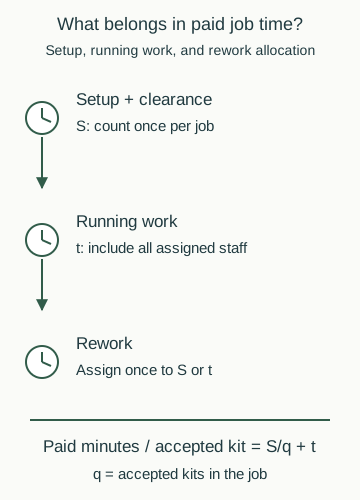
For a simpler time comparison, let S be setup and clearance minutes per job, t paid running minutes per accepted kit, and q accepted kits per job. Then paid minutes per accepted kit = S/q + t.
A proposed aid that lowers t but raises S may help long repeat jobs and disappoint on very short runs. Calculate the expression for the small orders you actually receive, the frequent orders and the awkward changeovers. Include rework in either S or t consistently, rather than counting it twice. For example, transitioning from a manual bench impulse sealer to a continuous band sealer machine cuts per-pouch sealing time while adding heater warm-up and conveyor height setup minutes.
PAC Machinery’s Rollbag brochure describes baggers fed by hand or by feeding devices. In the hand-loaded case, a quoted machine cycle cannot stand in for the operator’s complete kit-building time. Observe accepted output with the intended components, and compare the per-bag consumable markup against operator seconds saved in our tabletop bagging machine and pre-opened roll bagger cost guide.
Distinguish three different benefits
An eliminated overtime shift is a potential cash saving if demand and staffing support that change. Redeploying an operator can create useful capacity while leaving payroll unchanged. Shorter queues may improve responsiveness without either benefit being booked immediately.
Write down which outcome justifies the purchase and who can realize it. For a cash-payback calculation, divide installed investment by positive monthly net cash saving after recurring additions. A zero or negative net saving has no positive simple payback. Financing, tax and residual value need a fuller investment analysis.
Use the model to decide what to trial
Choose the uncertainty with the largest effect: setup minutes, accepted throughput, consumable cost or recurring service. Run the small-parts bagging comparison to resolve it, then revisit the worksheet. Avoid approving a purchase on a faster demonstration of a different product mix.
Methods and sources
Public kitting and bagging documentation defines the operational stages, while your floor time studies and accounting records supply the labor rates, setup durations, and accepted kit counts. Find related decisions in small-batch packaging. Updated October 2026.